

The final enable button argued against its own sensibility like a Monarch butterfly embarking on a thousand mile migration in winter. Its soft yellow pulse begged a second consideration of the heart with no one to hear it.
He thought about the delirium gripping Kurtz in his steamboat cabin. Every part of the boat—wheelhouse, mess area, the other cabins—wreaked of his approaching passage out of this world. The exhausted men around him could taste the brine of the Congo River instantiated with his fever sweat. Moonlight spilled over the ivory trader’s emaciated body through a small window over his bed. It was not easy to die like this without some declaration of truth.
The same full moon infiltrated the Combat Information Center from underneath, finding a tributary to follow, a stray thread of Congo no one would miss, handed off outside the jungle through time, so it never gets entangled with anything but meandering thoughts, desires and logics, like warm and cold fronts twirling around each other in a convective Polonaise dance.
As Nathan Collom felt it, the moonlight got into all their equipment regardless, Kurtz’s celestial benediction, his last moments fading in slow burn luminescence as it spread underneath the consoles of the USS Lake Erie and escaped upward, untouched, through that dime-sized enable button.
A fifth of something is always a fifth of what it is not, Collom thought, remembering his college history teacher who stood at a tall podium and read from his shabby spiral notebook about the events leading into World War II, listing each miscalculation and ignored whisper of avarice to the class for two hours straight, not looking up once.
The deep transfer of moon from Kurtz’s final breath into the control room ordained death in all its diluted forms, half-illuminating Collom’s face as if fulfilling just one more operational prerogative, a tactical ending. That blinking light wiped the staging protocol bare, cleared the Erie’s bridge. No idle exchanges about last night’s call home. This was the apocalypse finishing its letter to Collom with curt closure. One initial. No name. Yours Truly, A.
“Haven’t you heard?” his CO said. “The soul of man has wriggled free from its holding cell, thrown off its shroud like a final protest, risen loud into the night over the strait. And so let’s be done with it, yes?”
A moon is for nothing if you haven’t looked at it through a telescope, Collom thought, slipping back to his childhood in Jordan, Montana when he nearly froze on a hilltop one night while searching for Cassiopeia. He never found the constellation that night, but this did not discourage him from trying again the next and the night after that. After a while though, all stars in the sky look the same and one’s eyes tire.
Collom even as a boy felt reassured by solitude. Something about its irreducible nature, drawing him an exit map. When ensconced in groups of people, he yearned the most for its indivisibility, like Fort Peck Lake near his house, the way you could cup it in your hands and not come within a millimeter of changing its volume or constitution.
The silence in it fused him to his thoughts, turning books like Conrad’s Heart of Darkness and Barnes’ Nightwood into underground shelters, launching him like a paper boat with unexpected height and breadth onto a windless lake, drifting out there in full absorption, all the way to University of Montana Western, with an affection for disappearing in crowds, hiding his introspection in plain sight.
It was his affection after all, his homegrown blue tones buried under stoicism, his calculations of aloneness distilled to the last decimal place. No one else’s but his. And the possessiveness felt fine.
Bo Langlun, the assigned recruiter, felt drawn to Collom’s stiff will and philosophical range, but tuned into an even higher signal in the young man, his selective empathy for the ones who stood outside the common provinces of life, those who acted without worrying how the world might perceive them. Langlun could intuit Collom’s fierce and fluid mind after just a brief conversation about seeing the world, enlistment’s benefits, at a rickety table outside Mathews Hall.
Later that morning, over a breakfast of wheat toast, runny eggs, and under-cooked bacon at the Oxford Café, Bo suggested the Navy needed Collom. He asserted it as an asterisk in the conversation, in a loose way, with monotonous clarity, like reading out a phone number. He said he could see Collom as a Vice Admiral one day since you can’t teach someone to disassemble the world with an equal mix of curiosity and reverence.
With his confident yet detached gaze, Collom seemed one of the few who would take the world apart outside the pressure of time and beyond the reach of others’ agendas, examine each piece for its unique shape, see through to its significance, where it came from and where it could go and why someone would affix it to that place at that time, as if seeing every blueprinted layer of our construction as human beings for what it was, pastiche, hastily put together.
As Collom imagined it in that café, becoming a mechanical engineer for the Navy would feel like finding Cassiopeia through bleary and burning eyes. His drift from machinist mate to Surface Warfare Officer was a steady drip upward foretold by Langlun in a later deposition. It had a follow-your-heart quality to it, one propelled by a secret interest in yoking destructive capacities, ever since his childhood home burned to its foundation with his mother inside shortly after Collom’s 8th birthday.
He and his father had just found a perfect spot on Fort Peck Lake to drop a line, beside a fallen tree, when it happened. Stillness gives no voice to the violent outcries one comes home to. They are your own. An off-duty state trooper caught the 15-year-old arsonist hitchhiking back to Glendive, 30 miles north of Jordan, lighter fluid in his gray backpack, eyes as empty as a cellar.
As Collom climbed the Navy ranks, he found himself coming unmoored in between Sea Tours, sleepless nights accumulating in discord channels like Apocalypse Starter and Preppers35, spaces rife with conspiracy theories involving the repurposing of alien zero energy technologies for the complicit destruction of humankind.
Collom grew so entranced with the tenuous nature of matter, that somewhere along the way, the line disappeared between stopping total destruction and allowing it to unfold so he could investigate and record its properties in order to stop more destruction.
Collom thought about the charred shell of his childhood home as his finger hovered over the enable button.
Pressing it would rebuild it, set him down gently in the before-life, that cool September afternoon. His mother would breeze out onto the wraparound porch in her light blue weekend dress with lemonade on a tray. Nate hon, are you thirsty?
In baggy overalls, legs dangling over the rocking chair, Collom would sip his watery lemonade, air rifle resting across his lap, while waiting for the arsonist with the empty eyes to appear over the horizon. The enable signal would tip the scale one way or the other, to see if the heart outweighed the feather, and it always would, every time: a single nuclear-tipped Trident II arcing over the Hormuz coastline at zero hundred hours, 90 kilotons seeking refuge in a complex of enrichment sites.
The weighing. The judgment. The time before impact. All beckon the one who devours the conflicted soul, vulnerable by virtue of its paralysis. And someone like Collom on a Sinpo-class sub, bathed in the same red control room glow, would respond likewise, the two of them joined by filament, the mirrored tendencies of the universe, a brittle fuse, what some would call the material residue of fate waiting for one lit match to turn it to ash.
Should Collom press the button, nothing more would discover its verification in speculative ideals and moral superiority. We would forget why we had started messing with the atomic purity of the universe in the first place. Certainly not just to resolve differences of opinion about who deserves the overhanging thumb of authoritarian know-how.
Collom saw the conflict as nothing more than a children’s trading card game. One for one, or one for two, depending on the rarity of the card held. And if he stood up, removed his headset, and walked out of the CIC back to his stateroom, the ocean and mountains would shrug. His CO would place a check on a single sheet of paper on a clipboard and ask another SWO, probably Politz, to step in.
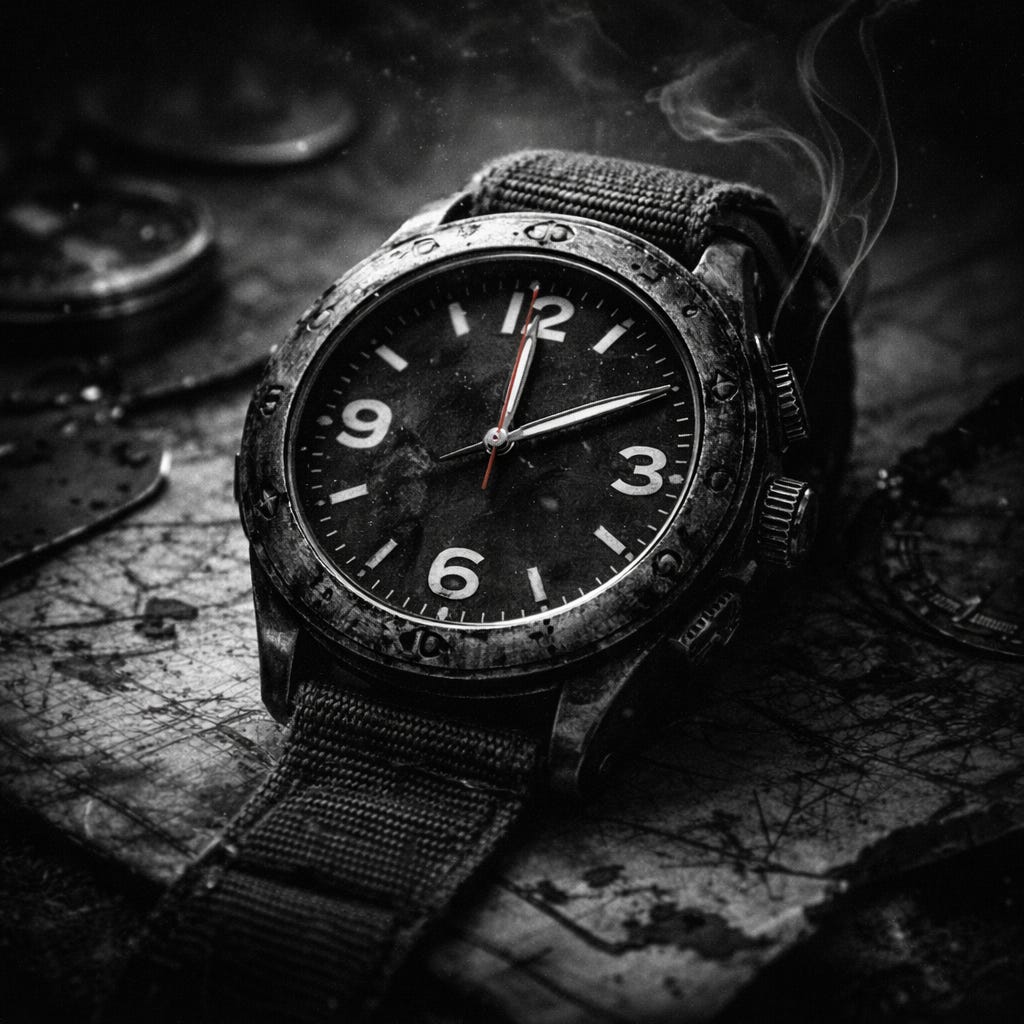
That’s how it would end. The redundant and circular nature of decisional integrity. Equal distances to order execution. No matter the crew’s configuration in the glowing room. Cog against cog. One lever pulled and a hundred watch wheels turning at once, rotating one half-turn around a miniature earth.
What does it mean to abandon oneself, Collom wondered, in an age of duplication and disposable wrapping, bodies, for the lack of something better to call them, not lost or found in their ordinary forms. They will never find their beginnings again.
What harm are we saved from or do we impose in windowed sleep through extensions of ourselves?
As Collom saw it, they might call such things children, these designs of longevity, these affectionate prefabrications of purpose.
Stars explode in supernovas, but not because they have stood too long on the threshold of great things. They have run out of the breath necessary to sustain their trillion-year resistance to crossing it. They do so for the simple pleasure of defiance, although no astronomer could prove it, even with their machine learning and self-propagating mathematics.
Try, try, try.
This, the pleading of the button’s light. And they observed him in the room, the pulseless eyes. Impatient for the other side of midnight, the luminous estuary of banyan trees and humid sunlight and mangrove snakes curving along the surface.
2359 hours.
To reset form and shape, cause and effect. Initial cause. Bridge to midnight. Twenty-five seconds that did not march upward as they should, in the order called upon—7, 6, 11, 5—staggering, getting close.
Try, try, try.
Collom stood.
“Go on SWO. Now.”
Don’t, don’t, don’t, don’t look at what’s in front of you.
Submitting to the smoke-chased infernal nature of ignition. Roar and sleep. Kurtz’s eyes pinned to eternity, pulling Collom close enough that he could interrogate night, relay those two words back into it. What horror?
Grayness without form. Here’s another extremity we have lived through. Here’s another. And another.
We will wring your heart yet without incantation. Unstained light. Pulse of blood in the ear.
“Now SWO or you are relieved.”
So he pushed it. Bird aloft. He sat down in front of the console again. Did you hear drums in the air as your home was burning? Hide yourself. You will be lost. Hide yourself. We will wring your heart yet. Eleven minutes and still no word.
Did they not bury me?
Try, try, try.
You can listen to this story on Apple Podcasts or here on Substack