

January again. A liminal snow coats the wheat fields and razor wire fences erected along Dryden Road. Zosia, wrapped in a black wool shawl, makes her away across the uprooted asphalt, vestiges of the bombardment from the night before. She emerges as a hunched over shadow from the line of soldiers on the East side, their rifles drawn in a neat row and aimed across the road. They do not flinch. Nor do they notice her breath rising among them like a mist. They do not pay any attention to the bundle she carries through the break in the line. Two parallel lines of a hundred rifles, holders silent, expressions flat, muted like the hours, facing each other across Dryden, her breath freezing as it meets the air. Zosia is now on the West side in Ludvig, the town of her birth, only a half mile to go to the village where she will move from house to house in no hurry, feet and hands numb, delivering venison from the farm storehouses to four families. She will repeat this journey two days later and two days after that. She will not make a fourth trip because she will have fallen ill, pneumonia, families gathered around her bedside saying a prayer for their beloved Zosia and another for Ludvig as they wait to see what will become of it at dawn.
The Terms
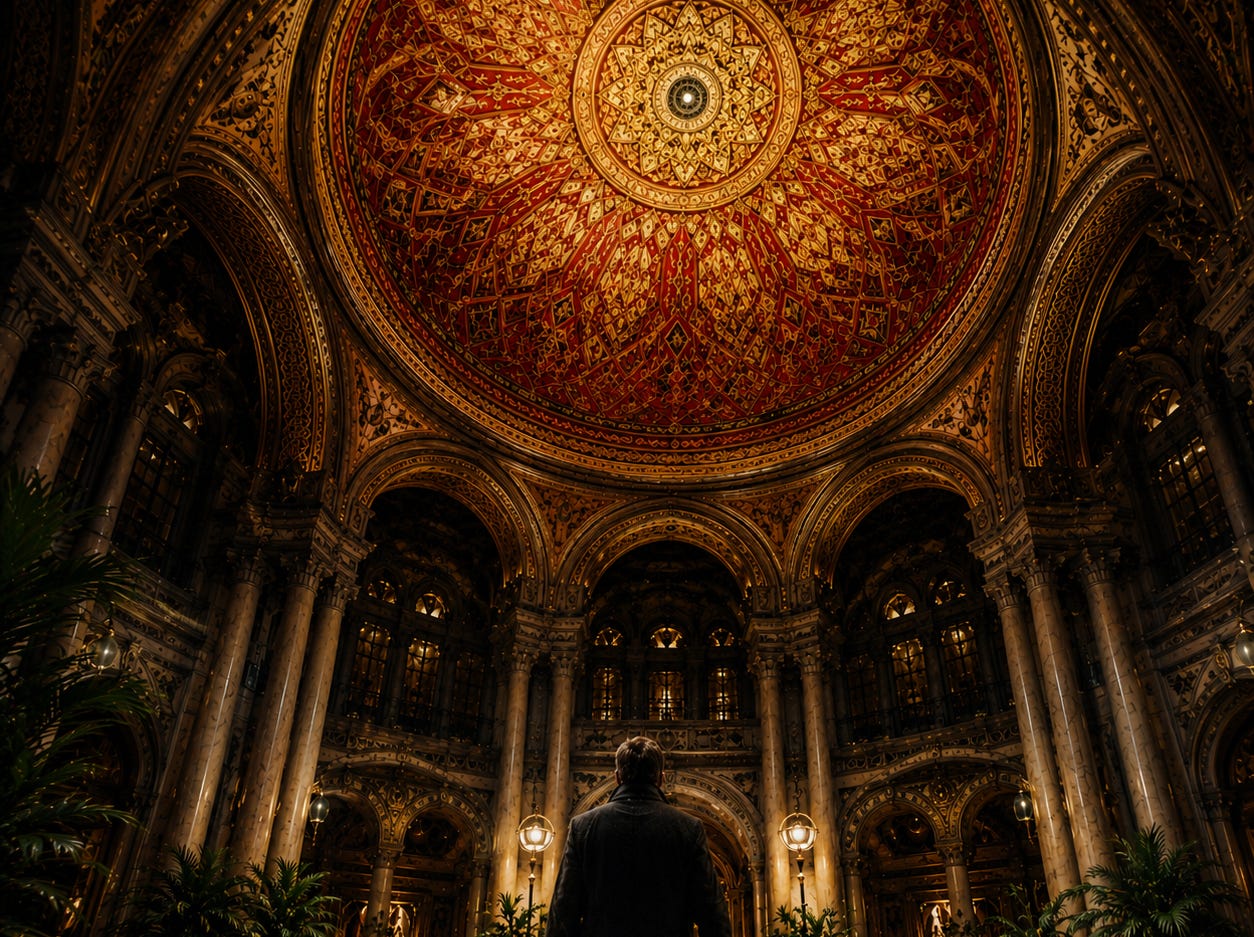
The ornate domed atrium at the Plaza d’ Oro in Litzin finds its heavenly aura at 3 pm each day when the sun strikes the gold and red-leafed geometric patterns arrayed around the ceiling, squares and triangles interlocking, overlapping in their right angles and hypotenuses, all of a Persian air. A single square table carved from ivory stands in the center of the atrium, draped in a white tablecloth, bearing two meticulous place settings of Wedgewood, pure silver utensils gleaming as though polished that morning, crystal water goblets half-full, no ice, and a vase with a white peony in full bloom.
Senik squeezes his Waltham pocket watch as if to trap time, imprison it in his palm while awaiting his counterpart Croyden to return with a position on the matter of the impasse at Ludvig. The crisp echo of shoes on tile announces Croyden under the atrium’s north archway, straight-lining to the table, possessed of a single mind, focused as sunlight through a magnifying glass, velvet folio under one arm. Croyden’s long mustache and heavy eyebrows speak of a perpetual fatigue as he takes the seat across from Senik, setting the folio down on the corner of the table.
“This is our last conversation about it,” starts Croyden, “I’ve been instructed to tell you.”
“Ahh, I expected as much from the weary mind of a donkey loaded up for the canyon descent,” said Senik. “Not the slimmest latitude of thought granted by Luchey since we’ve begun, eh? But go on. What other instructions?”
“Here is the reality, my friend,” says Croyden, his right eyelid twitching. “We have 5 lines of troops split by 3 lines of Panzer tanks, 2 sets of heavy guns behind the Panzers, and a thousand plus men who are hungry and cold and rather impatient staring down your thin village stop-gaps at the Western doorstep to Ludvig, which—and I will say this for what, the sixth, seventh time—was never was yours to begin with, never mind what the centuries have made you feel entitled to. So you see, you have nothing in all of God’s creation to give us the faintest pause in our righteous campaign of reabsorption, our only regret being it did not come sooner so as to squelch any whimsical hopes of nonattachment passed down by firelight from babushkas to their children’s children, you know the ones, with the wide doe eyes, rapt with dreams of frolicking in wilted wheat fields that were never theirs and never were going to be.”
Senik sits upright, unflinching amid the iron residue of Croyden’s first move in their tenth hour of negotiation. He studies Croyden’s quartz plateau of a face and considers the excess of force used, the elbow bent up behind one’s back by one’s opponent who hopes you do not see the reachable release point at the neck. Senik glimpses it behind Croyden’s stare, a tiny lit pinpoint of uncertainty.
“Then why not call the advance and be done with it? I’m sure your superiors have other menial tasks for you, Croyden, no? Some other pressing list of small humiliations that would save you from an afternoon here in Plaza d’ Oro with me, not a drop of jasmine tea or crust of rye in sight.”
“Because Luchey would like a full surrender,” says Croyden, opening the velvet folio revealing a single sheet of paper inside.
“Well of course he would.”
“AND a pledge of allegiance from the town’s council,” Croyden continues, tapping the paper.
“As a matter of course.”
“For the glory of the state, you see, for posterity.”
“The child running into her long lost mother’s arms,” says Senik.
“Exactly. You’ve got it!” Croyden says, pointing at him. “Along with a commitment to provide without conditions, for the duration of 35 years, unlimited access to your mineral deposits, silver and platinum, and a substantial percentage, say 40%, of Ludvig’s workforce to mine said deposits for the state for that duration.”
Croyden looks to either side unnecessarily, as they are alone in the atrium, and with a lower voice says, “I’m not supposed to tell you this, but there is some wiggle room there, with the percentage. I wouldn’t want you to come out of this nothing, Senik.”
“How generous of you. May I see the terms?”
“I have just told them to you,” says Croyden. “But if you must see with your own eyes, here they are, in black and white. No one wants a massacre, Senik. I’m sure you and your delegation would agree.”
He hands Senik the folio and Senik takes a moment to scan the sheet.
“Very interesting,” says Senik, as he reads. “Very interesting indeed. I bet Luchey’s sitting in his banquet hall surrounded by his generals as we speak, yes? Enjoying his favorite? Kippenborst and baked apples with plenty of cognac in celebration.”
“Oh you know, Luchey,” chuckles Croyden. “He cannot pass up the opportunity for a victory banquet with Kippenborst.”
“Hm, yes. I suppose not.”
“I almost forgot something,” says Croyden, drawing a sleek black fountain pen from his coat pocket and extending it over the table.
“Before I sign this, I’ve got something for you to have a look at,” says Senik.
Croyden places the pen down beside the vase. Senik places the folio on the floor and removes a sheet of paper folded in thirds from his inside coat pocket and hands it to Croyden.
Smirking as he unfolds it, Croyden asks, “What is this?”
“What does it look like?” asks Senik, matching the smile.
“Well, it appears to be a map of the Western line, our troop and artillery positions along Dryden road. What are these circles here and here and here?”
“You know, I always tell our delegation how perspicacious you are. I admire that in you, Croyden. Nothing gets missed. You are like a hawk always perched atop a pine tree honing in on his morning meal you are. No mystery as to why Luchey tapped you to lead these negotiations.”
Croyden snorts. “Negotiations. If you want to call them that. But thank you, Senik.”
“Those circles mark the burial points for the devices. And as you can see, they lie by my estimation, given the movements of the last week, directly under the tank line and your third and fourth line of troops behind that line.”
Croyden, still smirking, stiffens a little. “Devices. What sort of devices?”
Senik folds his arms in front of him, shoving the place setting toward Croyden so it knocks into the vase. “The kind that go boom.”
“You think a few planted land mines changes things,” says Croyden.
Senik shrugs. “The atom is an incredible paradox, don’t you think? Something so small that it cannot be seen, yet when forcibly divided, capable of consuming the entire world with the fire of hell.”
Croyden shakes his head. “You are decades from the technology for it.”
“You’re right,” says Senik. “WE don’t have the technology for it. But our friends on the Southern continent do, you know the ones I’m talking about, in the disputed Ibrimium Territories. You know them, the ones who have endured nearly 60 years of relentless persecution in your labor camps. What you don’t know, and our counterintelligence has made sure of, is that for those 60 years, their best and brightest have secretly been smuggled out with our help and trained in physics and engineering in friendlier countries, the ones with the capability and materials, Luchey’s quieter enemies, waiting patiently for their opportunity. And I would remiss if I did not tell you that this opportunity is now, as we sit here, you and I, without a drop of jasmine tea in this beautiful domed atrium. And oh, those extra hours of our back-and-forth, inching ever closer to a signed agreement of surrender, made the room needed for some small adjustments to the timers and triggers. Simple to do, a turn of a knob, so much so that an ailing grandmother innocently carrying food across the lines to her people could do it if she knew exactly where to crouch down along the way. Your divisions, Croyden, with their rifles drawn and Panzers idling are sitting directly over 72 kilotons of explosives. Oh I’ll take that back by the way.”
Senik snatches the map from Croyden’s hands, refolds it in thirds, and tucks it back inside his jacket.
“Wouldn’t want you to guess the locations of our buried treasure, now would we? Looks like you’ve grown a bit pale. Would you like some water? Shall we call for some?”
“You mean to tell me, you would dissolve your entire people,” says Croyden, “poison the earth beneath Ludvig and air above, for hundreds of miles surrounding. This is what you are saying.”
“There is a phone in the annex. I have but to make one call and it is done. The people of Ludvig have decided unanimously that they rather rise to heaven than spend a single day under the thumb of Luchey’s rule. You are done here, Croyden. These are our terms. You will withdraw your forces and never again set foot within 50 miles of Ludvig. You will, however, pledge your protection of our small territory, guarding its independence and autonomy indefinitely from afar, and you will also close the Ibrimium camps and free those people and leave the Southern continent. Do you understand these terms? Answer me, you shad. Because after these 10 hours, I have little patience left for ambiguity.”
Croydon swallows hard and stands, looking like a spinning top that has come loose from its string. He nods. Senik stands and extends his hand.
“Shall we shake on it?”
Croydon nods again and offers his hand. Senik takes it and squeezes hard.
“It’s been a pleasure, Croydon. You may return now to your feast in Brechnev and announce to Luchey and the generals that you have single-handedly brought this matter to a close. And please note to them that those devices will remain in place, under close watch, for years to come should you try anything clever. But we should grab a gin, one of these days. How about it?”
Senik claps him on the side of the shoulder. Croyden turns and walks like a man to the gallows, disappearing under the north arch of the atrium, not turning back for one last look at the victor. If he thought to, he might have spotted the tiny beads of sweat forming on Senik’s forehead and heard Senik’s small sigh of relief as he slumped down into the chair at the empty ivory table. He had an important call to make, but figured it could wait an extra minute or two, as he stared up into the red and gold mandala of domed geometric cacophony, thinking about how a homeland is child of sorts that never grows up, always on guard against those who would take advantage of it, if not for the custodial responsibility handed down across the generations to sustain its survival amid the avarice and desperate dominion of fearful men.
You can listen to the cinematic version of this story on Apple Podcasts, Spotify, or here on Substack.
It inspires me to write when you share a story you really like with someone - thank you :)