

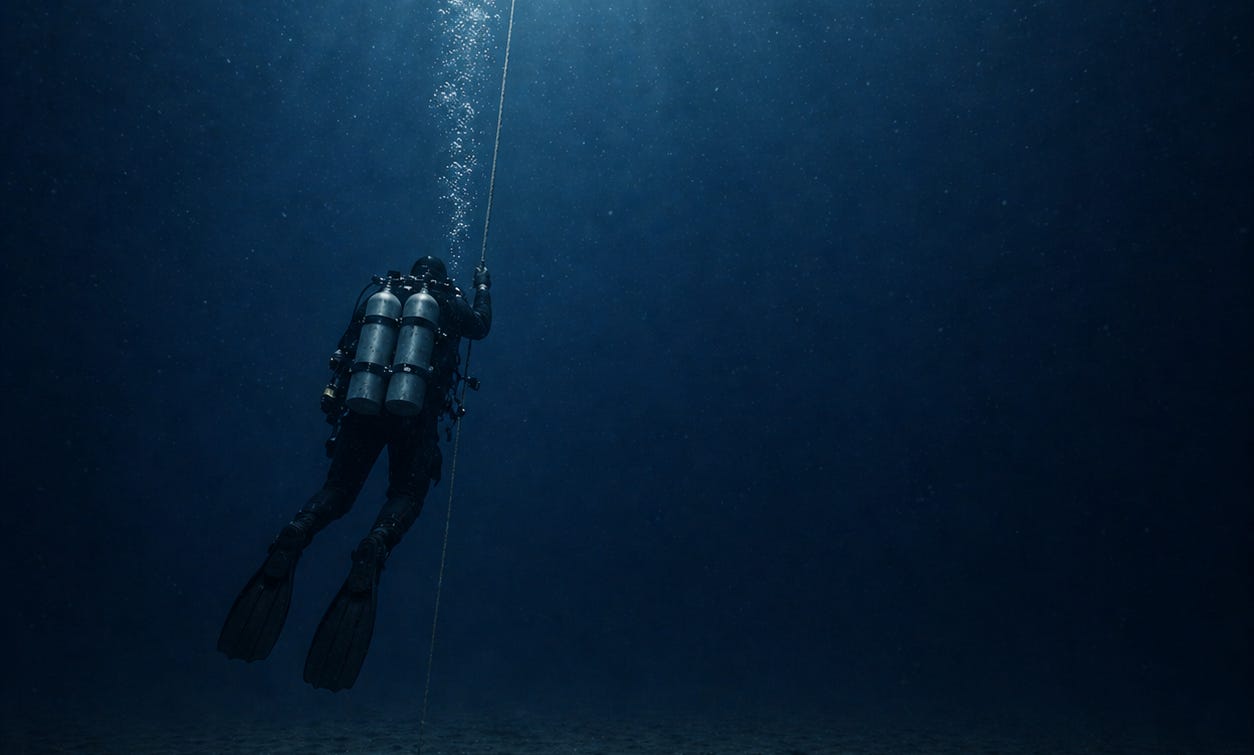
It’s what no one tells you. Drop-line wrapped around your arm. Shoulder dislocated. How the ocean 220 feet down is like leaving your body, your memories of last week and last year, your ideas of sunlight, your wife and kids, your prognosis, your bearings, your basic arithmetic, your up versus down—leaving it behind, all of it, because you have no other choice. At that depth, with your tri-mix running out, you have to be ready and willing to shed everything you hold dear, the clothing that made you real, your exteriors and your way of speaking, your Saturday interests that other people recognized you by, every goal you ever entertained no matter how far-fetched, like finishing a second doctorate in anthropology and learning how to play spinning glass bowls with wet fingers and traveling from the Black Sea coast to Istanbul in a hot air balloon, all the dressing up of a life that clings to you as much as you cling to it. You have to be willing to let it fall away from you at depth, every part of it, without resistance. For this is no soft interworld of blue-gray inner space or low atmosphere prelude to outer space or idyllic Sargasso Sea painted slapdash one afternoon by an impressionist. This is how you approach an ending where the only sound is the hush of air through your regulator on each short breath to preserve your time, whatever that means now, and the bubbles escaping, the carbon dioxide you have to let out, one less circulation of air in the meticulous universal accounting of all the circulations you’ve been granted since birth. You approach twilight at 220 feet like sitting at a small round table in an empty jazz club waiting for the band to come back when you know they’ve already left for the night. They left hours ago and aren’t coming back.
Bottom time after an 8-minute descent is 15 minutes and you’ve been there now for 40 minutes and your dive partner, your friend, your teammate of 20 years, godfather to your son is lying motionless on his back on the hull of the overturned yacht beneath you. There is no time for grief. There is no time for hindsight. There is no time for reviewing your life and replaying all the poor decisions and revising the stupid things that came out of your mouth. But more importantly, there is no time for the 15 stops you need on the way back up that would allow the nitrogen and helium to safely leave your body. While you could emergency launch yourself to the surface by filling your buoyancy vest, you’d likely be dead by the time you got there or shortly thereafter from your lungs overexpanding and the embolisms that come with it, air forced into your bloodstream heading straight for your brain and heart, helium and nitrogen bubbles like a disturbed ant colony swarming out of every body tissue and lodging in places they shouldn’t be, every joint, every artery, every vertebra.
The mission as they laid it out shoreside seemed straightforward, stepwise, blueprinted with if-then solutions to all conceivable crossed wires, debris snags, equipment failures, and mathematic miscalculations, everything except for the magnetic anomalies, the geomagnetic spikes that kept cropping up around the Catalina Terrace. Nothing you could do about them, but the specialists assured us they had poured over the data and picked the right window. These magnetic field variations corresponded to sharp increases in sea floor density, 5 to 10-minute peaks of concentrated gravitational force across a mile-wide area which the navy speculated had caused the sinking of at least fifteen small vessels around Catalina Island over the past few years, including the 65-foot Irwin yacht Bellina upside down beneath us. Most of the peaks hit during the winter and spring months and only a few occurred between July and September. The threat assessment that Sunday morning in August remained low. Sky clear, wind non-existent, sea traffic at a minimum, no amplitude increases that sometimes predicted the spikes.
So we splashed in at 0800, ready with our well-rehearsed entry and exit path: descend to the bottom on the buoy line and swim up into Bellina. Its stern had lodged in the sea floor at a slight angle that would allow just enough of an opening if we removed our tanks and vests, dragging them in behind us. Once inside, we only had to swim 20 or 30 feet to the master stateroom where we would search for the target, either in the under-berth drawer beneath the main bed platform or in the room’s safe. We brought an exothermic cutter in the event Grayson had stashed it in the safe. The cutter now lay beside John on top of the hull. Topside had gone quiet. Surface, can you hear me, John’s gone. They couldn’t. No was coming.
It happened toward the end of our descent, so fast you could only react by reflex. A little less than 40 feet to go to Bellina’s hull and the baitfish around us scattered. We felt a deep vibration, a rumble, what an underwater earthquake might feel like. The moment I felt it, I knew. I wrapped the buoy line three times around my left arm and yelled to John “spike!” but he only had one hand lightly touching the line and the massive gravitational surge yanked him off it like a leaf in a tornado, sucking him down at a speed I estimated at 50 miles an hour, slamming him against the fiberglass hull of Bellina. My shoulder separated. I screamed into my regulator. It felt like a giant had wrapped its arms around my legs and was doing everything it could to pull the rest of my body away from that line-wrapped arm. Everything went dark as if I had slipped under with anesthesia without counting backward from 5.
When I regained consciousness, I flailed in my disorientation. Pain knifed through the left side of my body, reminding me of how much trouble I was in. I went straight for my SPG. 600 psi. I tapped the gauge. 600 psi. Not enough gas to get back to the surface. You’re taught in SEAL training that if you know you’re not going to make it, if you’ve exhausted all your options, you do whatever you can to complete your mission. It was the same way with my gall bladder cancer, my oncologist placing his hand on my shoulder, telling me it was Stage IV. Mission above all else. We would do what we could until the end. I had a mesh lift bag. I had a knife. If I could get down to it, the thumb drive in that safe or drawer would set us up pretty well for off-world exploration and military superiority for the next 100 years. They didn’t tell us what was on the drive, but my guess and the whispers around it pointed to schematics for an anti-gravity propulsion system that Bill Grayson had designed during his time with Reed Aerospace, reverse engineered from downed UAPs and one in particular in the Taurus mountains of Turkey, the size of a football field, so large it couldn’t be moved, where the propulsion system underneath the object had remained untouched, pristine since it had come down like Bellina on its crown.
I cut my dangling left arm free from buoy line and floated down like a jellyfish, past John, to the sea floor, my head lamp cutting a path. The opening underneath Bellina appeared larger than the ROV mapping suggested so I didn’t need to remove my equipment to slide in. Using my right arm to pull myself along, I navigated down the narrow hall toward the master stateroom, pausing to push away sheets of fiberglass batting from the ceilings and walls and going slow so my tanks didn’t snag on the exposed electrical wiring and I didn’t catch myself on the two detached doors I passed or the splintered wood coming in at dangerous angles or the broken railings. Once inside the stateroom, I reached up to the bed over me and found the drawer handle set close to the floor, now the ceiling. When I pulled it out, folders, papers, and two spiral notebooks drifted down—and a red flash drive. I grabbed it, put it in my vest pouch, and checked my SPG. 400 psi. At 7 atmospheres breathing at .5 cubic feet per minute with about 10 cubic feet of air left, I had about 5 minutes. I hurried.
When you know it’s getting close to the end, the cold of the ocean at depth presses in, the chill carving its way through your dry suit to your skin until there is no escaping its blade, every inch of you shaking uncontrollably, but also with a tranquil inevitability, a peace of mind you can only experience immediately after the trauma of being born and just before body and mind reach their final small stretch of runway. Nothing bright just yet, only that infinite field of blue-gray twilight and the cold. I placed the drive in the mesh lift bag and was about to pull the red trip line that would pierce the CO2 cartridge and inflate it when I sensed something behind me. I turned and there within arms-length hovered a yellow and brown spotted Goliath Grouper, the largest I had ever seen, 8 feet long. With the smallest flicks of her fins, she floated in place, mouth parted slightly, yellow unblinking eyes locked on mine. I closed my eyes and felt her presence, a very old intelligence, somehow part of me and part of the same force that shook the seabed and dragged John down to his end and which now ushered me to the edge of mine.
No.
The word, a drip of lava, burned a red-yellow streak through me as it fell down across the screen of my mind into my chest and stomach.
No.
I loosened the top of the mesh beg and took out the thumb drive, holding it between my thumb and forefinger, now almost void of feeling, my hand shaking. The Goliath, statuesque, opened her mouth a little wider. I flicked it toward her, the drive tumbling in slow-motion, end-over-end, toward her jaw. She lurched forward, snapped it up, and swam off in the direction she had come from, vanishing into the blue-gray expanse.
The breaths I could take from my regulator grew shorter and shorter and I began sinking back down to the sea bed. I waited for the illumination they promised, a signal as if from a distant lighthouse, blinking then solid, then blinding, wrapping its cold fire around me until I was fully saturated in it, indistinguishable from it. Reuniting or restarting, traveling out over the Catalina Shelf. Once beyond, plummeting down thousands of feet into the unseen world, twilight now a full flat darkness without sound. I would come to rest at some point, having let go of my tanks and dry suit along the way and the boundary of form and shape. They all would be waiting for me there at the bottom to tell me I had done okay. I had done what I was meant to do.
You can listen to the cinematic version of this story on Apple Podcasts, Spotify, and here on Substack.
