

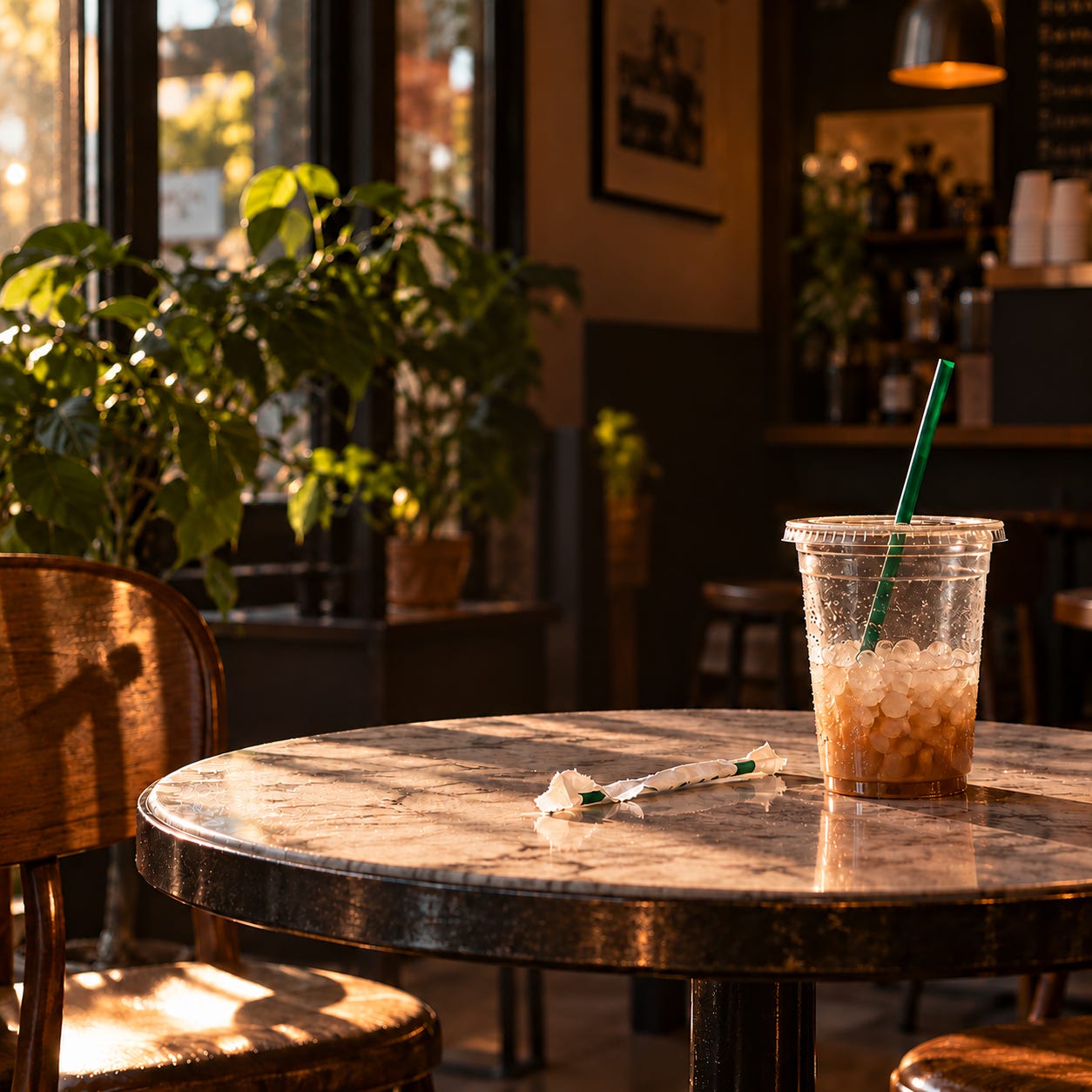
These are the three things you see in the coffee shop on the way to your funeral:
A torn straw wrapper.
A plastic cup of ice.
A photo of coffee beans on a branch.
You thought your name was Edward. But then you remembered your mother hated that name because it reminded her of a ruthless king. She named you Edward and asked you not to change it. Your mother’s name was Eleanor. She enjoyed wearing a long red robe to Dunkin’ Donuts on Sunday mornings. You slept in. You woke up at half past noon. You said so this is what it’s like. You went back to sleep.
She brought the donuts to the park and fed the geese. The geese ate so many they had trouble flying away. They decided to live out the remainder of their lives on a baseball diamond overgrown with chicory weed.
She would later tell you a children’s story that began: It’s never a good idea to feed geese who haven’t yet flown south for the winter. You ask what would happen. She takes out an ironing board and gets the tie you would be wearing and leaves the iron resting on it until you smell smoke.
Shhhhhhhhhhhh.
But…
Shhhhhhhhhhhh.
A young woman in a suit tells you a secret.
She took the photo of the coffee beans in Costa Rica.
On the slopes of a volcano in the Central Valley.
She says that someone wanted to throw her into the acidic crater lake to avoid a state of disillusionment. She said okay. They smiled and shook their heads. She pointed to the photo on the wall and said there’s the evidence of your survival.
The Food Mart across the street attached to the gas station is run by an advanced intelligence. Sometimes it pumps the wrong gas into customers’ tanks. Premium instead of regular. Diesel instead of unleaded. Sometimes at closing, after a long shift, it looks up at the stars with longing and asks why this or why that. Someone left a pile of license plates beside the air pump. They all say The Sunshine State and nothing else.
Edward got down to the ice and saw what was left in the cup.
Pellets of ice.
He only wanted the ice.
But when he got down to it, he thought glaciers! and fled.
The procession continued down Route 70.
They closed two lanes to make it more difficult. No construction. They added a large striped sign with flashing yellow lights. There never was any construction. Three black SUVs with tinted windows turned off into the parking lot of the Home Depot and idled there, because they had Arthur on the paperwork.
Your name was Edward, not Arthur.
Arthur was visiting his cousin in Saddle River.
He also had a mother named Eleanor but she wore a white dress, like a bride, to Dunkin’ Donuts on Sunday mornings. She ate all of what she bought herself and never gave them to the geese—who could have been happier, but for some reason weren’t. They had arranged themselves along the green base paths and sat there staring at each other.
Edward waits for the rain. You wait for the rain.
There are just a few clouds in the sky resembling islands.
Edward counts the petals of a daisy, to be sure.
He tears them off one-by-one, the petals.
It was white or yellow, the daisy was.
He tapes each petal back on while biting his lip as apology.
The flower counter at the supermarket is busy. You tire of taking off the petals one-by-one. The butcher reads Night’s End when no one’s asking him to weigh meat. He wrote to the author and declared there is no end to night.
You leave the supermarket without any flowers.
Edward develops a slight cough. You suggest he eat a fragment of coal you found along a trail in the woods. He says he prefers the taste of honeysuckle. You say there’s nowhere to get honeysuckle at this hour.
The doctor arrives in a Jeep Wagoneer with a long silver antenna soldered to the roof. He explains it is for the advanced intelligences, only one of them, working a double at the gas station. And of course, he forgot his stethoscope, but says he can use his hand and tap into the etiology of a life.
It’s measles.
It’s pneumonia.
It’s the common cold.
It’s none of these.
The SUVs have left. Three orange shopping carts in their place, one behind the other, each containing a bundle of brown lawn bags. You walk to the edge of the cemetery. It takes you four years to get there. Edward already came and went. He’s sitting near the plot at the far end, the one by the fountain, biting his lip. You denied your mother the pleasure of naming you. There are no geese in the sky or on the ground or south of the cemetery, not anywhere.
The straw wrapper is still on the table in the coffee shop.
No one has sat there.
No one has thrown away the cup of ice.
The photo of coffee beans on a branch holds the side of a hill that was once underwater and once on fire and once like the surface of the moon.
The sky fades from black to a brilliant blue, but no one sees it because they are inside, at their tables, reading something or imagining something or traveling somewhere or staying put or arguing on the phone or withstanding time or ordering a muffin.
There’s a man with a beard sleeping alone in one of the chairs. Soon he will be asked to leave because it’s the next morning. He will ask where the young woman in a suit went and they won’t have an answer because she used to work there, she used to get her coffee there, and then she didn’t do either.
He will get into a black SUV and it will take him to his wedding ceremony. He and Eleanor will move into a modest twin, Western side of the city. They will have a baby and try to decide what to name him. They will avoid naming him for as long as possible. They will plant a thin row of yellow tulips leading up to the front step. The tulips will die because it’s January, but not before finding themselves in a photograph taken by a mail carrier whose bag is filled with unaddressed postcards.
She reads them to herself at night, the postcards with sprawling vistas. The alarm clock makes the sound of rain. Each one begins Dear Edward. I want to tell you how the sky looks when no one is looking at it. You will grow up someday to be the man I met who fell asleep in the coffee shop, thinking of his child, trying to remember what his face looked like by the light outside his window.
This was not the end. It was going to be. But it was not.
Your father, Edward, drove you into Arestes State Park to the winding access road and let you out on foot to find the cabin beside the stream. When you found the cabin hewn from pine, you pried your way inside and felt the cold of its enclosure and thought this will not do either. So you began to take it apart, board by board, until the stream and the scattered boulders around it could find no evidence of you.
Your father said goodbye twice.
The first time he said I’m leaving with the next meteor that scrapes the sky just above the horizon before dawn. You thought he was joking. And he was. The second time he said it will all depend on how you take down what has accumulated—the roads, the cities, the vegetation too. You set about the work of dismantling what has arisen, with a mild sadness and an eye toward what you could keep. You kept none of it. You scraped an X in the dirt with your fingers.
Edward, your father, now in his 70s, says goodbye a third time after picking you up where the access road once began. He says good job with all of that and have you ever thought what it would feel like to step out onto a comet’s tail as it whips around the sun and crosses low over the Northern hemisphere. From what height, you ask. He says questions have a weight to them. He leaves you on a hill overlooking a stream overlooking another hill and goes to do what he promised.
You figure the taking apart does not include the stars or planets. But it does. It’s difficult work. You are meticulous in your gathering, keeping count of the innumerable. You lose track and start over from zero. The advanced intelligence gives up on the gas station across from the coffee shop on Route 70, which is no longer there. It has nothing to do and so it sings. There is nothing to do, so it meanders. Through the open field of night. Through the heated gases and nascent stars and celestial echoes.
The burial did not take long.
Only a few words were said.
One of the geese had returned and stood off to the side and craned its neck.
Eleanor arrives in a light blue dress, what she calls cerulean. The sun is shining. She says I have decided on a name, but I will not tell you until you are safely under. She changes her mind and leaves.
You can find the audiodrama of this story on Apple Podcasts, Spotify, or here on Substack.