

I. Algorithms
The more Theo Hart tried to do nothing, the further away he got from it. So he learned to stop trying to do things, for doing anything had become unnecessary. And that’s where nothing waited for him, lounging at his doorstep, ready to envelop him beyond effort in a nondescript state of what-else-is-there. At 42, Theo had never married and never wanted to have children, because what would they do with themselves? He worked platform programming jobs first in the clothing industry, then in the war industry, then in the toy industry—until the algorithms took care of those jobs for the workers, all of them at once.
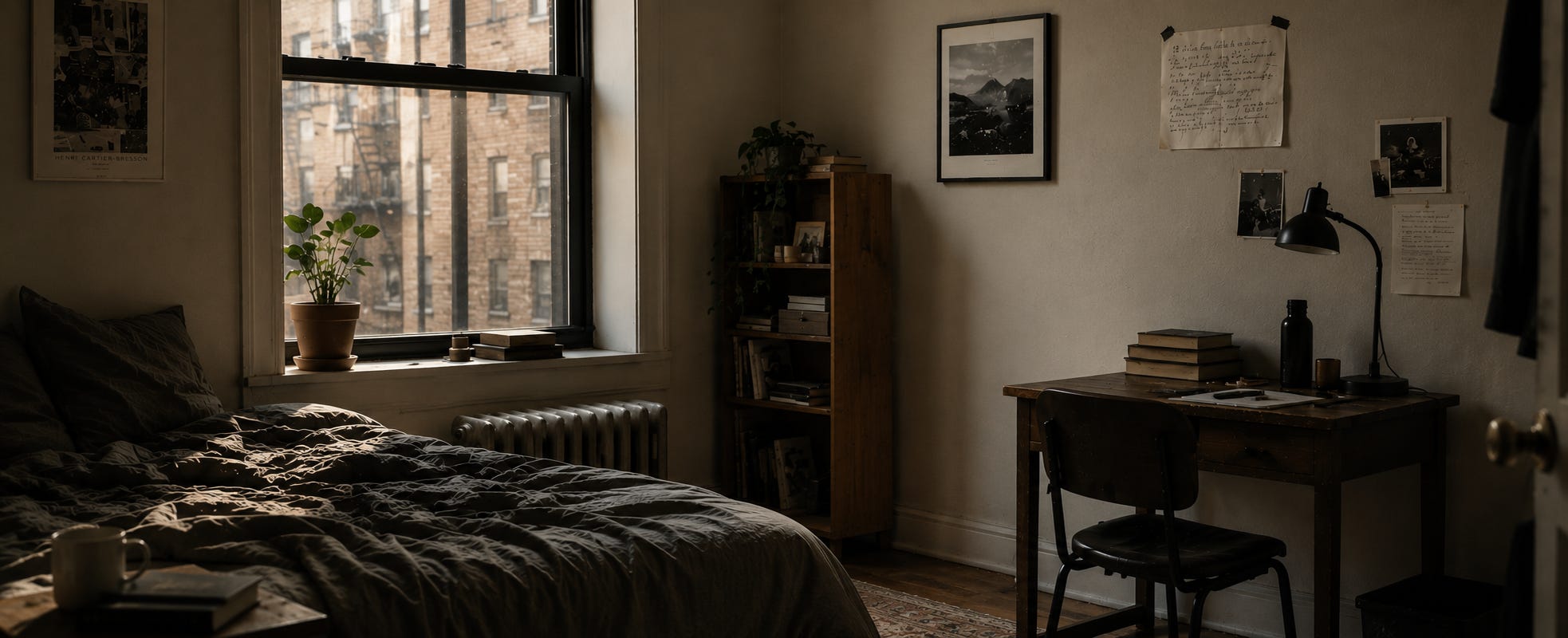
Theo planned to spend his time reading but could not find places that still sold books. He remembered books from when he was a boy growing up in North Jersey, the weight of them in his hands, the earthy smell of their pages, the serpentine adventures they contained. He lived in a small apartment in Northeast Philadelphia above a pizza shop, slept on an air mattress, and enjoyed as much time as he could without screens—but no books and nothing to do. Theo would lay on his air mattress for hours and stare at the ceiling’s water stains which reminded him of a wolf’s face. Nothing does not like to be pinned down or called out. It likes to rest beside you, undisturbed, and does not appreciate crowds.
Over a period of weeks, Theo learned the rules of nothing, its preferences. He figured out what made nothing enjoy the time it spent with itself. He learned that nothing detests the spotlight. He learned that nothing is quite happy with its invisibility. He learned that nothing is most comfortable, as you might expect, with questions that don’t have answers. On most days, it won’t respond to what you say. On most days, it won’t even respond to your presence. Whispering may get you a little closer to it. Saying nothing could bring you alongside it, but that’s all that will happen. There is no grand revelation about nothing to be uncovered. It does not peer into you and you do not peer into it. This is the agreement Theo had with nothing in his small apartment. It is assumed. It is implied. It is a silent understanding few notice when they pass it on the street.
Theo learned that he could feel complete in nothing without guilt or shame. There is nowhere else he needed to be. No one else he needed to visit. Nothing else he needed to say. This is how it has been for hundreds of thousands of years, he thought. This is how everyone always thought things would stay. But just like all the programming jobs, Theo knew that nothing stays the same forever.
II. Something
Theo only left his apartment to get something to eat and do his laundry. Most people stayed home like him, the in-dayers. On an out-day, one warm May morning, Theo stepped out of his building and a bicyclist nearly collided with him. She swerved and braked hard, her front tire skidding, the bike frame scraping along the brick wall of the building to a stop. She wore an old green army jacket and carried a clear bag of five-sided fidgets over her shoulder. She gave Theo a good long glare and said hey what’s the idea and next time watch where you’re going. When she saw nothing in Theo’s eyes and heard him say nothing in response, she softened and asked the one question he wasn’t expecting: why aren’t you doing something? He said, How do you know I’m not doing something? She looked him over and said come on, really? She then offered to sell him a fidget for $5. Theo said he didn’t have $5 and shouldn’t everything be free anyway because of the algorithms. She said he had a point, drew one out of her bag, and handed it to him, saying remember, something is better than nothing. She got back on her scraped bike and pedaled away.
The more she made her rounds, selling fidgets, in some cases handing them out for free, asking the question that seemed to jab people on the block awake, the further that riptide spread. Soon everyone got swept up by it, thinking they should be doing something. But no one knew what exactly they should be doing. They could fidget for only so long before they tired of spinning it in their hands. They looked everywhere for a sign of what they should be doing next: outside, inside, in the forests and deserts and oceans and cities. No sign appeared. As time passed, everyone chose something and claimed it as theirs. They carried it wherever they went. They wore it on their sleeves. They talked about it over meals. They celebrated its presence alone and with others and at every possible turn. Most in-days became out-days. When asked their names, they would point to the one thing they had settled on. It was something. It had weight, substance, gravitas, status, meaning. No one wanted to let it go, not even for a second.
Mothers demanded their children receive something as soon as they were born and so they did. People would not relinquish the something they had organized their lives around except upon death and even then, they could not figure out whether they had truly left it behind or brought it with them into the next world. After many experiments and countless double-blind placebo-controlled studies, physicists declared that something had indeed occurred. Something had come into existence with mass. All the known forces, including gravity, acted on it without prompting, as if knowing a priori what to do. Over time, the world became something, large and overarching, and at the same time composed of something smaller, microscopic, atomic. Things went on like this for thousands of years and it all seemed okay because finally there was something to it.
It seemed that the only person who had not picked up something was Theo. The fidget stayed on a green lawn chair that doubled as his bed stand in his small apartment. His in-days remained in-days. He did nothing without trying to do nothing, as he had learned. Days like pages on a tear-off calendar passed like perfect mirror images of the ones that came before.
III. Nothing, Again
On one of his rare out-days, Theo spotted the bicyclist coming down the sidewalk toward him, this time with a clear bag over her shoulder of neon water pistols. She stopped and gave him a polite hello and it felt a little awkward. She put her bag down on the sidewalk and looked him over. She could tell Theo had not yet traded nothing for something and asked why. The only answer he had for her was nothing, and she frowned, a clear indication his answer wasn’t good enough. It fell short of something, even if that something couldn’t be named, even if it had nothing to do with a water gun fight on a hot day. I have to tell others about this, she said, a sense of regret in her eyes. She picked up her bag, slung it over her shoulder, and pedaled away. The news took some time to spread, but not that long, a week or two at most. For those to whom nothing felt like a faraway memory, those who were now doing something—and this was the great majority, nearly everyone—said Theo must leave. Not only the block, but the city. He had to go away from them. A lot of them showed up at his apartment to make sure he knew just how serious they were. For nothing, they argued, cannot stand beside something for very long without seeming to mock it. Theo abided, because what else could he do? He packed nothing because he had nothing. He took nothing with him to a faraway corner of the world and lived there without people and that was fine with him because it meant no one would ask him whether he had something to do. It did feel lonely though. Nothing, when present for long enough, can become an unbounded emptiness, but it also remains full of possibility if you’re open to reminding yourself that there’s always a great expanse of possibility where nothing is.
Theo was sure no one would come looking for him since they would assume there was nothing to find. Nothing could be forgotten, so that’s what they did. They forgot about it and they forgot about Theo, blocked him out, because at the end of the day something is incompatible with nothing, insoluble to it, unaffected by it, immune to it, and wants nothing to do with the memory of something it’s not.
IV. Wear and Tear
For years, it was great to have something to do. Something to take up the hours. From fidgets to water gun fights to playing music to a hundred other pastimes. But something odd began to happen. People began to think of something as a burden, a responsibility they had to fulfill, a cloud following them around, the joy of it faded, replaced by a mild irritation at first and then a discontentedness and then a sense of being worn to the nub, threadbare. When some went to swap something with something else, it helped for a little while but soon the same nagging inertia returned, only worse. Out-days turned to in-days.
Maria, the bicyclist on the block, set down her bag of flutes on the sidewalk and left them there. She noticed people had this hollow disoriented look in their eyes along with a tiredness that seemed to saturate every part of their being. She thought of Theo and how he was somewhere in a faraway corner of the world doing nothing and maybe very happy at it. She tried to remember her own days of doing nothing, before she took the job with the bicycle shop, and she couldn’t. There was nothing there, nothing at all. This gave her a feeling of relief, surprising her.
Maria figured that if it gave her some relief to think of nothing, remember nothing, and envision nothing, how she and most everyone at one point did nothing, then others might feel better in wading into that place as well. The problem was, with all these years spent centered around something, nothing now seemed like a lock box missing its key. They needed help returning to nothing, restoring it to the center of their existence, replacing something with nothing until the cows came home. For this, they needed someone who lived with nothing and slept with nothing and spent all his waking hours with nothing. They needed to find Theo and decided they would spare nothing in finding him.
V. The Art of Doing Nothing
They came to him one-by-one and in small groups, discovering a path to his faraway corner of the world by using heat maps and GPS and crowdsourcing. They seemed elated to discover his lean-to made of branches and fern leaves. Sometimes when Theo came out he would find one person, sometimes two, sometimes 40 or 50. They always asked him some version of the same question: How do you do nothing? Or, what is the key to a life of nothing? Or, if I drop something, will I be forever bound by nothing? Will nothing sustain me? Do you get lonely with nothing? If everyone has nothing, would they fight each other for no reason or fall in love? Would memories of something disappear the moment a person held nothing in their arms, or would those events that marked something of importance fade over time? Can you exist in a meaningful way with something and nothing side-by-side? What would a day in the life of nothing look like? And would it still be worth living?
As Theo looked into their hungry travel weary eyes, their thin bodies swaying in the occasional saltwater breeze, the answer was always the same. He said there is an art to doing nothing and being nothing that you have to figure out for yourself. Now, I know you have come all this way, a thousand miles for some of you, but there is nothing I can tell you in a definitive way that would alleviate your worries and dull your fears. You have to sit back and close your eyes and breathe for a little while. You have to not try to look for anything inside or out. You have to say to yourself there may be nothing behind something and nothing behind everything, nothing to witness and nothing to put your arm around, saying this is it, nothing to be gained and nothing to be lost, nothing to unpack or put away, nothing to depart from and nothing to return to, nothing that is yours and nothing that isn’t. And the seekers would nod, looking just as uncertain as when they had arrived, and begin in many cases their long journey home.
The truth is Theo did envy them for having something and wished he could have gone back with them and made something the center of his life like they did and for once, have something in common with others that they could talk about and argue about and pine over and show to people to say this is what life is supposed to be about, something that answers the central question of why we are here in the first place. But the truth was also that there is no analytical way of going from nothing back to something. There is no clear schematic or set of turns one could follow. He wanted to tell all the people who came to him with their desperate gazes that they all had nothing inside them already. They didn’t have to go anywhere or talk to anyone or ask him questions to discover it. Nothing is the perpetual sound and the perpetual silence. And isn’t that reason enough to be alive?
Like stories read to you? You can listen to this one on Apple Podcasts, Spotify, and here on Substack.