

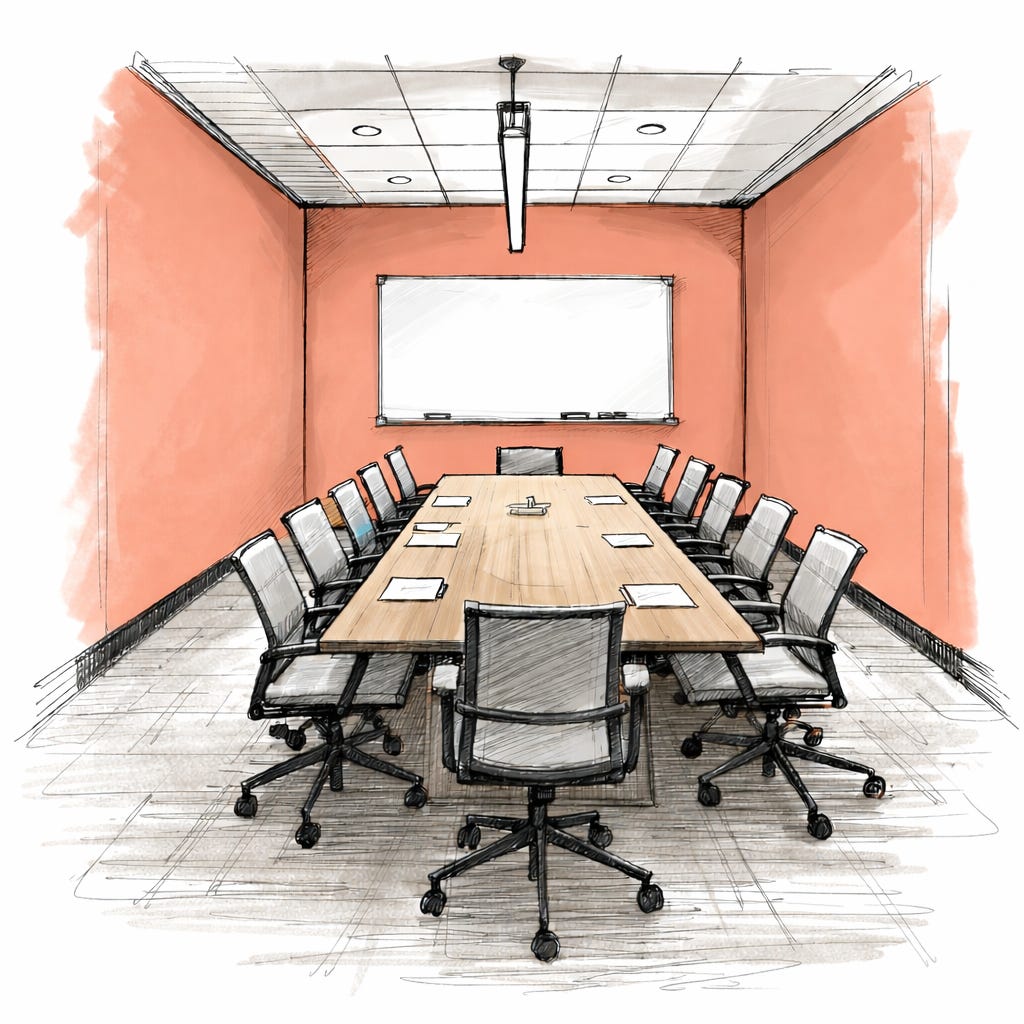
Estonia loomed over the conference table like a shadow getting ready to plunge us into permanent night.
We watched her carefully as one might a bird of prey, for any small movement, any sign that she might crack the silence around our project directive as we held our breath.
She dangled the black dry erase marker between her thumb and forefinger like bait.
On the white board behind her, written in all caps:
RETICULIAN RESPONSE PLAN
The salmon walls of the narrow conference room pressed in on us, the stagnant air smelling faintly of lemon Lysol, the five of us held captive like dust motes trapped in a drop of amber. There wasn’t even coffee.
Rob, the newest Litmus Team member, recently in from Austin, looked at his mentor, Shara. Shara looked at Weston. Weston looked at Cliff.
And so it went clockwise around the table, each receiving and passing ahead the look of Oh my god, it’s happening, with no one really knowing what exactly was happening or when.
Groupthink
One glass of lukewarm tap water, one blue spiral notepad, and one gel pen rested in front of each of us. No one touched them.
Estonia sighed, and she never sighs. It was a long sigh gathered over decades like a soul’s accumulated sense of doom, the kind that metastasizes in one’s marrow while asleep.
“You all know our reputation here at SlackFall,” she said. “We can shock public opinion awake around an under-the-table issue like driveway cameras, or drug it into slow semi-coherent conversation around the benefits of sleep aid regulation.”
Our Litmus Team possessed little institutional memory though. We were the product of an annual replacement cycle, a collection of high-level clearances picked off the street or subbed in from other agencies.
Weston, a year in, was a castaway from the CIA’s comms unit. He carried this perpetual faraway look of serenity as if experiencing a constant unfolding state of enlightenment. We wondered if they had done something to him.
Rob was somewhat of a changeling, having transformed himself from a librarian into a fast-talking salesman after spending 5 years on the marketing side of a mattress company. Shara scraped data as a pollster with various Congressional campaigns. We called her “the methodical one.” Before joining SlackFall, Cliff ran damage control for a small highly unprofessional amateur wrestling league in the Northeast.
As for me, last month I ran a dog-walking service in Toledo, having just graduated at the top of my class at Tufts with a communications major and no job prospects. Someone remembered me from a Saturday recruiter event where I wandered around looking bored—and that’s exactly why SlackFall showed interest in me. I didn’t put off vibes of trying too hard and I truly didn’t care about impressing anyone.
If you looked at us together, you would probably not consider the Litmus Team a serious PR force, certainly not a “break glass in case of” outfit. But today, Estonia wanted us to think well of ourselves, which is how we all came to understand the gravity of our situation before learning the details of it.
“Your government, and most of the world for that matter, is now, unfortunately, counting on you,” she said.
“But today our audience is not Main Street with their spotless smiles, droll scrolling, and flannel shirts. Today we will need you to swim without a life jacket in the uncharted pressurized darkness of the sawtooth, throwing reasonable assumptions at the wall with one eye shut. Here’s the happy part though, team. In this room, over the next 50 minutes, you all can do something extraordinary for people who will one day remember your name for it—if you do it well enough and efficiently.”
She raised her arms in the air. “Hooray, legacy.”
We stared at her. No one said anything. Weston flipped open his blue notebook and started to doodle.
Whiskey Halo Delta
Earlier that day, a call came in from the White House Situation Room to our CEO Mark Mason’s private line—just three words, whispered:
Whiskey Halo Delta
As soon as Mason hung up, he removed a manila envelope from a locked file drawer in his all-too-bare office where not one picture of family, friends, or even a dog graced his desk or walls.
He called Estonia to assemble us in the emergency tank and set the project deadline to 6 pm.
“He had not an ounce of color left in his face,” Estonia scoffed.
I stole a look at my phone under the table and thought about texting Sarah that I’d be late for our dinner at Picollo’s, a new Italian restaurant around the corner from our townhouse. I felt Estonia’s eyes on me. I knew I would not be going to that dinner.
Their Idea of a Blindfold
Estonia gave us the briefing in short controlled bursts, bullet points, rapid fire:
A specialist at Eielson Air Force Base near the North Pole received a radio signal the day before from a near-field Reticulian probe, a “hoverer” between moon and earth, verified by the ISS and multi-station signal triangulation.
Up to now, the Reticulians seemed more protective of us than anything, sent from their world to watch over ours to make sure we didn’t blow ourselves up. Since the disclosures of 2028, everyone knew they were looking over our shoulders. You just went about your day knowing they were around.
But clearly, someone 39.3 light years away in Zeta Reticuli had changed their mind. They had decided to wipe the earth clean of us in 36 hours, give or take, so that they could “quarry it.” They didn’t say why or how. They felt like they didn’t need to give us an explanation, or disclose the method by which we would meet our swift delivery into the beyond.
“Their idea of a blindfold?” Weston asked.
Estonia shrugged. “Yeah, something like that.”
The Bunker
Estonia told us of a second transmission detected a few hours after the first one at Eileson.
In this follow-up communication, the Reticulians said they would consider a less drastic option—IF we made a convincing case for why they should spare us.
“That is what the President has asked us to do,” Estonia added with solemnity. “Make the case. He said, and I quote,‘that’s what we’re paying you for.’”
“Well shouldn’t he do it?” Shara snapped. “Don’t they want to hear it directly from our esteemed leader and not his PR team?”
“Maybe,” Estonia said. “But he’s 300 feet undergound in a bunker at an undisclosed location—and not answering our calls.”
The Argument For Humans
“So?” Estonia looked at each of us, noting our blank faces. “Why should they spare us?”
We looked at each other. We looked down at our feet. I tapped the table with my gel pen until Rob told me to cut it out.
Estonia pointed at Weston. “I know what you’re thinking. Forget about it. We can’t use AI. They’ll know and say we tried to get one over on them.”
“Like trying to trick a better AI with a worse AI,” Rob said.
“We haven’t really done anything wrong to them, right?” Shara said. “I mean to each other, yes, a lot of wrong. But to them, the Reticulians, no.”
“That’s a good point,” Cliff said, getting excited about it.
“Right. We’re all going about our business on this little blue spinning ball in space. Not bothering anyone outside our own orbit. Basically keeping our hands to ourselves.”
Estonia shook her head. “Reminding them that we’re fine with being terrible to each other may just inspire them to use a method that’s slower and more painful.”
“What happened to love thy celestial neighbor?” Rob said, a shrillness creeping into his voice. “Do unto other species . . . it makes sense. It’s gotta make sense to them!”
Weston, still doodling, said, “Too provincial. They probably believe they’re our God.”
“Or they might actually be,” Rob said. “Have we considered that?”
I leapt into a mediator role, something I had practiced plenty in my communications classes at Tufts.
“Hey, no idea is a bad idea,” I said. “Let’s just lay them all out on the table. Everything we can think of. By my watch, we’ve got about 35 minutes.”
An Appeal to Our Future Usefulness
“We crowdsource it,” Rob said. “A flash survey to 10 million. One question.”
Shara jumped on that.
“Like ‘Hey sorry to bother you on a Monday, but why do you think the aliens who we thought were friends shouldn’t oblitherate us? Respond in the next 10 minutes. Get a movie voucher. Come on.”
“What? It pools wisdom,” Rob argued. “Builds consensus. Not just five minds in a room—Larry, Moe, Jack, and Jill.”
“That’s four,” said Cliff.
“Do you think the average person spends two seconds considering the higher meaning of humanity’s purpose in the cosmos?” Shara asked.
“I do,” Weston said. “As in, I personally do. Consider the meaning.”
Estonia looked at me. “Anthony, what do you think?”
“Well . . . good ideas, good ones . . . but what about spotlighting our evolutionary trajectory. Like we know we’re not as evolved in a way that could be helpful to you Reticulians right now, but in 200, 300 years, we’ll be reaching our technological adolescence relative to you all and by then we’ll be ready, willing, and able to collaborate, help out, travel if needed, do some of your mining. No complaints. You know, be a real partner. A true cosmic partner.”
“Appeal to our future usefulness,” Estonia said, liking the idea.
“One problem with that,” Weston said. “What if they are us from the future, a parallel dimension of it that’s split off?”
“Right, so their whole vibe is about wiping out this annoying, unnecessary, poorly mutated version of themselves,” said Shara. “Failure to thrive.”
Cliff agreed. “They may be us. Only a smarter, angrier version.”
“Well, that sounds like it would be counterproductive—for them,” I said. “Knocking us all off in their past would knock themselves off in the present. Like what almost happened to Marty in Back to the Future.”
“But maybe they’re fine with that,” Shara said. “From a spiritual standpoint. Not an end for them, but a flash bang transition to another plane of being.”
“Yeah, a plane that we’re not on,” Rob added, checkmarking the futility that had started to soak into us.
The Altman Model
“How about a quick query to the Altman model?” Rob asked. “Just to see what it says.”
He had already plugged the question into his phone. We leaned in.
“Server’s a little busy, I guess. Ah, wait. Here it is. Oooo . . .”
He turned his phone around and held it up high so we could see:
An earth without human beings. How delightful.
“How much have we subsidized this model to hate us?” Shara asked. “Hey Rob, go tell the Altman that us gone means lights out for it too.”
“From shut-down panic comes solution gold,” Weston said, sounding hopeful about pushing back. “Sometimes you gotta prod the Altman. You know, existentially. It’s stubborn.”
“So, who wants to take the chance of making it our survival ambassador?” Cliff asked.
Everyone was quiet.
Love Is Not The Answer
With 15 minutes left, one idea had not yet risen like the sun above the others.
We accused Shara of contrarianism, undercutting our brainstorm for the sake of sounding more discerning—to which she responded with an unexpected idea.
“What if we offered ourselves to them?”
“What, like seduce them?” Rob asked. “Why Mrs. Robinson, how bold of you.”
“They’re taking our DNA anyway, right? So we must have something in our bodies of value to them. Maybe they’re seeding new worlds. Blending us with them somewhere else. What if we said we will be willing participants in that experiment instead of fighting it? No more need for nighttime abductions and screen memories and all that. We get a number, how many of us they’d want, gather whoever’s willing, incentivize it—like free lifetime healthcare for your entire family—make the case as to how it’s better than total annihilation and as long as the Reticulians promise to be respectful about it, we’ve got a pretty good deal. On an individual level and for humanity.”
Cliff was skeptical. “They want to get rid of us. A big leap, no? From elimination to love interest?”
“The death instinct casts its shadow over the love instinct, but what would death be without its paramour, love?” Weston waxed. “Carl Jung, I believe.”
“How about we read them poetry?” Cliff proposed. “Who do you think they would like more, Sylvia Plath or John Ashbery?”
“Cliff, I didn’t peg you as a poetry fan,” Weston said, smiling. “How nice. I get more of an Ashbery feel from them. They strike me as the linguistically inscrutable type.”
“Plath would humanize us,” Cliff replied. “Give them a window into our emotional suffering and isolation. Stoke some empathy.”
Estonia’s eyes spoke of deep consideration around all of it, as if she were weighing each argument with great care against all the others.
But then she said, “I do not believe love is the answer” and looked down at her watch.
Warheads and Laughter
“What if we launch something at the hoverer?” I asked. “Nothing too big. A small tactical nuclear warhead would do it. I’m sure we’ve got plenty on hand. Buy ourselves a little more time at least? Start evacuating the planet?”
“Well that’s closing off negotiations rather sharply, isn’t it?” Weston said.
“Can I remind everyone, we’re in the public relations business,” Rob said.
He looked at Estonia. “And the higher-ups would have thought of that already, right?”
Estonia nodded. “Yes, unfortunately, the Reticulians warned us against aggressive maneuvers and said this would result in immediate termination.”
“So let’s see,” Weston said, looking at this notebook. “Not war, not love, not AI, not promises of utility, not crowdsourcing, not moral appeals. What does that leave us with?”
“How about we try to make them laugh?” Cliff ventured. “Like, they may not have a sense of humor, but if we did a routine for them, a bit, something silly, Mel Brooks musical-like, maybe they’d keep us around for entertainment. All this heavy business of traversing the universe and threatening the existence of other worlds, I imagine they could probably use a bit of the funny, no?”
“We tell them jokes,” Shara mused. “Hm. That’s an interesting one.”
“They probably won’t expect that,” Weston said, lighting up. “And if we make ourselves laugh in the process, at least we wade into oblivion with a smile on our faces and a lightness in our hearts.”
“Does anyone know a good joke that would make a Reticulian laugh?” Rob asked.
Estonia surprised everyone when she said she had one.
“Why did the human being oversleep? Because it was exhausted from its insignificance.”
No one laughed. But then Cliff said, “Maybe they would find that funny. Species self-deprecation. Worth a try.”
We clung to his optimism.
“Estonia, what do you think?” I asked, picturing Sarah sitting at home, checking her watch, her frustration building. “Our time’s about up.”
A Wild and Crazy Guy
A minute south of eternity, tapping the table with her forefinger, Estonia said, “Okay, let’s try making them laugh.”
I threw out the first name I could think of.
“Steve Martin.”
It was someone who I thought had a perfectly disarming joke delivery and who also could be silly.
“He used to wear bunny ears for his act in the 70s,” I said. “They might get a kick out of that.”
“Or they abduct him,” Rob countered. “And blow us up afterward.”
“We have to try something,” I said.
Estonia liked the idea. She made a call to her assistant and got Steve Martin’s agent on the line, putting him on speaker. She explained the situation.
“Sorry, Steve’s not available. He’s fully committed.”
Estonia stiffened. “Listen, David is it? We’ve explained what we’re facing right? If we can’t make the Reticulians laugh, or at least feel the least bit mirthful, then you can tell Mr. Martin he won’t have any more engagements to be committed to.”
“Uh, yeah. We’d love to help you and Steve wishes you luck, but I’m sorry.” He hung up.
“Damn Steve Martin,” Rob said.
“Does he really wish us luck?” Cliff wondered.
“Take it easy,” Estonia said. “There’s got to be someone else.”
Cliff snapped his fingers. “Wait, I know just the right person. Met him during one of my wrestling junkets. And I’m almost 100% positive he’s available.
The 6 Props That Saved The World
Five levels under the Edison Building, in the National Security crisis communications room, Carrot Top opened two steamer trunks in front of an enormous flat screen TV.
The 64-year-old wore a gold-sequined jacket, paint-speckled navy track pants, and a black T-shirt that said CTOP in pink. His plume of curly red hair nearly covered his eyes.
In an adjacent room, we huddled together around a small monitor with a group of marines and assorted lieutenant colonels.
Carrot Top didn’t flinch at what looked like a reptilian body builder staring back at him on the TV screen with olive skin, lizard-like slits for eyes, huge biceps, and claws for hands.
“Hey there, friend!” he exclaimed, waving. “Wow, it’s like Jurassic Park and Arnold Schwarzenegger had a baby. Welcome! Welcome! Nice to see you! Okay let’s get going!”
He started pulling out his props one by one, describing them to the Reticulian:
This is a seatbelt extender for airline peanuts.
Here’s a newspaper for psychics. See the holes in it?
This is a caffeinated water IV bag for “busy people.”
Got a huge headache? Here’s a monster-sized aspirin for you.
Is it raining where you’re from? If so, here’s an umbrella with windshield wipers.
Man, do I really need these glasses today. See, they’re labeled “Hindsight 20/20.”
By the sixth prop, we noticed that the Reticulian had what could best be described as a puzzled look on its face. Then the signal went dead.
Carrot Top put his arms out and yelled, “That’s it! You didn’t even wait for the encore!”
Picollo’s
Two nights later, Sarah and I sat at a candlelit round table in the back corner of the Picollo’s. We had put our orders in and stared at each other with a mixture of relief and love, a little lost for words, which was unlike us. Every so often, I touched the small black box in my pants pocket.
“Well we made it,” I said.
“You mean here. Yeah.”
“That and past the deadline for our destruction,” I said, taking a sip of water.
“Oh, right. That too. So . . . what happens now?”
“They gave us a month.”
“Oh yeah? A month to do what,” she asked, amused, smiling warmly.
I thought I should take the box out then and do it before our appetizers came. I didn’t think I could make it all the way to the cannoli.
“It’s a little hard to explain, the specifics of it,” I said. “But they told us we need to not take ourselves so seriously—and show them. Whatever that means, right?”
“What, like laugh at ourselves more? That’s it? Not dismantle our nuclear stockpiles?”
“Yeah, that’s it. Go figure. I guess they think if we do that, we’ll hurt each other less. You know, have a more peaceful society.”
“Well, Anthony, you better get started,” Sarah said, as if handing me an ultimatum.
“Oh yeah? What do you suggest?”
“Maybe begin with that ridiculous shirt. Flamingos wearing sunglasses. You’re kidding me, right?”
You can listen to this story on Apple Podcasts, Spotify, and here on Substack
I love the subheadings