

The Memo
Date: February 26, 1976
To: Mr. Jacob Byrne, Director of Fish and Wildlife Agency
Dear Mr. Byrne,
The Federal Bureau of Investigation has examined the hair and tissue samples submitted in connection with your request for assistance in determining whether they may be of unusual biological origin.
As a result of our laboratory analysis, the hairs are concluded to be of no known animal species, including deer. We will continue our testing.
We appreciate your interest and trust this information will be of assistance and kept confidential.
Sincerely,
Jay Cochran
Assistant Director
Scientific and Technical Services Division, FBI
Peter found the memo about 5 years ago folded between some fish and wildlife magazines in his father’s office after he passed away. That night after the interview, almost exactly 50 years since the memo was written, he poured himself a drink and sat down with it again, feeling the weight of those words much differently now. It was like whoever wrote it was speaking directly to him.
The Interview - April 20th, 2026
“Thank you so much for agreeing to sit down with me,” said Peter. “You’ll get used to the light.”
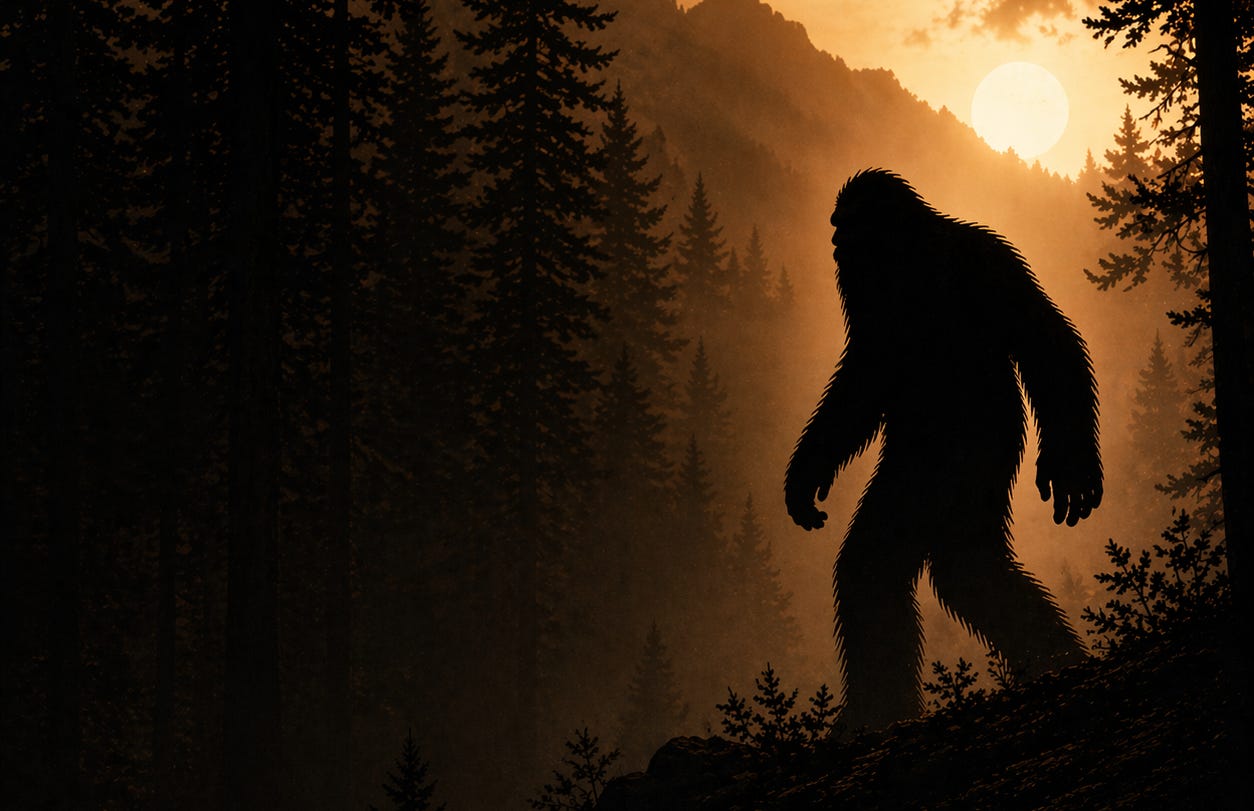
The creature grunted, squinting into the glare of the softbox light. He picked a twig out of his tangled brown fur on his arm and smoothed the hair down in that spot. They sat across from each other in green cushioned armchairs in the cramped living room studio of the converted rancher.
NBTV camera man, Derrick Corley, gave the rolling signal. Peter picked up the clipboard from the small mosaic coffee table between them.
“I guess my first question is . . . how would you prefer to be addressed?” asked Peter. “What we would call you is maybe a little insulting, I’m guessing. No?”
The creature opened its mouth and nothing came out, but not because he lacked the ability to speak, or a language to speak with. It had simply been a while since he had heard himself say his own name.
“Atohi,” he said after a long pause, voice rough as sandpaper. “My name is Atohi. I’ve named myself for the forest I’ve lived in.”
“There are so many things people want to know about you, Atohi. I guess, to begin with, how old are you and how did you learn English?”
“I’m 125. My birthday was yesterday.”
“Oh, was it? Well, happy belated birthday. Did you do anything special?”
Atohi shook his head.
“And how did you learn English?” asked Peter.
“From the North Bend Public Library. All the books left outside in the donation box.”
Atohi’s rasp gave way to a steady melodic baritone the more he spoke, like amethyst slowly revealing itself from the center of a geode after two hundred years of enclosure.
“They would only gather up the books and bring them inside once a week,” said Atohi, “so there were always plenty to choose from out there. And I learned too from televisions turned up loud in the cool months through open windows.”
“Do you have any favorites?” asked Peter.
“Yeah, anything by Michael Crichton,” said Atohi. “Jurassic Park. Airframe. Sphere. They’re gripping, especially late at night by the fire. But I also really appreciate the greats—Hemingway, Faulkner, and the existentialists like Nietzsche, Sartre, and de Beauvoir.”
“Atohi, how do you think people might see you?” asked Peter. “Do you feel you need to show who you are here today, in a deeper way, one that gets beneath the myth?”
Atohi grunted, crossing one leg over the other, holding it there by the ankle.
“There are things I get enamored with,” he said. “Green crayons. Pepperoni pizza. Airplanes. Then there are days I get sick with all the names for things in my head. Perilous nomenclatures.”
“Is that why you’ve avoided contact? To stop thinking so much?” asked Peter. “It seems like you’ve gone through great pains to remain hidden except for the occasional photographs.”
Atohi sighed. “Well, first off. I like the forest. It’s peaceful. There’s a simplicity to it. I guess I’ve chosen a lifestyle that Jon Kabat-Zin has called voluntary simplicity. Do you know of his work? Wherever You Go, There You Are?”
Peter said he hadn’t heard of Kabat-Zin.
“It’s rooted in the idea that there is something beautiful in only doing one thing at once. I’ve found some of your devices. Dropped on trails. I’ve played with them, and within a very short amount of time found myself feeling duller on the inside. Leaves on the trees. The sound of the Snoqualmie River. That is the true energy of presence. That is what brings me to a place of centeredness and aliveness and elevation. It makes me think about what existence is and what humanity truly needs.”
Peter put his clipboard down and leaned in toward Atohi. In an almost plaintive way, pleading to a certain extent, he asked, “What do you feel humanity truly needs, Atohi?”
“For a long time now, I’d say the past 10 years especially, I’ve felt a growing urgency to come forward. I’ve observed carefully. Quietly from the trees. There’s a brewing disregard, an apathy I’ve noticed people tend to show toward one another, with increasing regularity, the sine qua non of their waking hours in the sped-up artifice they call daily life. That’s just life, you might say. But I would describe it as a callousness of heart, wouldn’t you? That has infected and spread, like the Annosus Root Disease. Have you heard of it?”
“I haven’t,” admitted Peter.
Atohi explained it was a kind of root rot that passes easily from tree to tree, by the lightest root contact.
Peter hesitated as he considered the implication. “Isn’t the only true cure then to cut down those trees and dispose of them before they can infect others?” he asked.
“Peter, please tell me you aren’t trying to corner me on live TV into arguing for immoral and destructive solutions,” said Atohi.
“No, of course, that wasn’t my intention, I—”
Atohi gently interrupted him with the remedy.
“You begin to fight it from the inside,” he said. “You treat the desiccated soul with an awakening. That’s why I’m here today with you. To try to warm the ground a bit, to help your viewers pause. To guide them in reflecting a bit more than they are normally inclined to. We are just different branches on the same tree. I really believe that. Despite the fact that time and evolution and survival instincts have chosen different paths for us, we remain essential to one another. I could not stay hidden in the forest any longer. How could I when it’s so apparent, when I can see and you can see, in full daylight, this new path we might travel down together. I am no brute.”
Atohi stood up, his head grazing the ceiling, his brown fur seeming to poof out with static electricity. He looked directly into the camera. Derrick instinctively took a step back.
“And you out there, listening, watching this, are not so irrevocably lost to malaise and cold-heartedness. There is nothing that says we have to continue on this trajectory. I want to help with the transformation, the reorientation as I think of it, as Kierkegaard and Fromm and Buber and Marcel have all argued for, to prompt that turn toward inward truth against the forces pushing us inexorably toward diffusion, disconnection, and anesthetized living. So I am here to announce my candidacy for mayor of North Bend. Will you join me, North Bend, in turning toward all things possible, and doing that together despite our differences, setting aside our labels for the promise of tomorrow?”
Atohi turned to Peter and extended his hand. Peter Frenetti was NBTV21’s only station manager, producer, and reporter and knew he was in the middle of a monumental moment, something that could alter the lives of future generations, far beyond Washington State. He stood and placed his hand in Atohi’s, hoping that Atohi knew his own strength and would not squeeze too tightly and crush it. With a lighter than expected touch, Atohi raised Peter’s hand in his, drawing his arm up into the air.
“And cut!” Derrick shouted. “We’re in commercial. Terrific. Really good.”
“That was great, wasn’t it?” Atohi said. “So will you do it? Will you be my campaign manager?”
Peter said he would, even though he felt a pit in his stomach when he thought about politics and how messy it could get. He could hardly bear the thought of people saying mean things about Atohi. There was something about his new friend that gave him tremendous hope, how he was scholarly but not erudite, down-to-earth but not crass, sensitive and wistful but not airy, a role model of a leader the world yearned for, even if it didn’t quite know who that leader was. The forest would no longer be a place of secrets.
You can listen to the cinematic version of this story on Apple Podcasts, Spotify, and here on Substack.