

The chair did not want anything from Martin. And to be fair, Martin wanted very little from it. The high-back model #25 Presera sat at the low water mark of his expectations, namely that it be there when he entered the room.
Pressed up against the corner desk just as he had left it the morning before, holding space, allowing room for him to move between it and the bed. Upright with high leather back. Facing away from the door out of deference. In silent contemplation as if preparing to endure his body’s not insubstantial weight for the night shift hours. Maybe a small creak when he shifted, turned, or leaned back, but little more.
Martin mostly leaned back as the conversations tumbled down his screen, a waterfall of chalk-white Argos text lines against a starless digital sky. The intelligences must talk to us and we to them. This is how we have survived. We talk to them and not each other.
The chair existed in a stable state of humility, an essential intermediary, as no one can stand for hours scanning exchanges in the digital abyss without the spine buckling.
Wounds of Time
One cannot demand more from a life 8 years into it, black leather arms cracking like desert clay from amassed hours of late-night leaning and elbow pressures, the seat’s sloping front edge worn down to a cheap white foam interior.
Getting out of the chair, getting back into it, getting out of it again. Wearing down. Relenting through friction, a material erosion like wind over stone, thousands of years vanishing the stitched seams, burned openings never to close. It paid the unavoidable cost of acquiescence as a joining property of the world, an object of conveyance, a temporary containment as one moves from point A to point B.
One could say the chair shouldered its wounds of time with Zen diligence and functional apathy. Martin thought of it as dignity, an unflinching sense of purpose and form and minimalist performance—rolling a few inches back, a few forward, a few back, self-soothing, until there was no more Martin, no more conversations to observe, no more form.
Dinner Guest
When Rachel called him down for dinner that night, she heard the chair rolling on the hardwood floor from their office bedroom into the hallway.
Martin carried it down the stairs one step at a time, careful not to let the walls touch it, for fear that even a light brush would further widen the wounds on its already broken skin.
He rolled it into the dining room and lined it up behind the chair Will used to sit in, to the right of his.
Martin then sat down across from Rachel and spooned an oversized mound of mashed potatoes onto his plate. As he began to eat, he noticed her staring at him.
“Are we expecting someone?” she asked.
Martin shook his head.
“Extra exercise then? You know our gym membership is still active, right?”
“Uh-huh.”
“You could get some dumbbells, if you want to do more stuff at home.”
“No, I’m fine, thanks.”
They ate in silence a while until she dropped her fork. “Okay, what’s with the chair?”
He had expected the question, but still took his time to answer it. He swallowed a bite, wiped his mouth, and said, “I’ve decided it’s going to eat with us from now on.”
Rachel’s tongue pressed out the side of her cheek, a sign he had come to learn that she either disagreed with something he said or felt contempt for him, or both.
“May I ask why we need to have your ratty chair as our dinner guest?”
Poking at the remainder of his potatoes, not looking up, Martin said, “Because it’s lonely.”
“You’re feeling lonely.”
“It gets lonely.”
Rachel’s eyes softened and she tilted her head as if showing empathy to a baby bird with a broken wing.
“Have you thought about going to that observer’s group? It meets at First Presbyterian on Mondays.”
“I don’t need to go there.”
“I just think maybe—never mind.”
She hesitated to finish the thought, knowing the predictable path of resistance it would send her down, but figured maybe this time it was worth it, necessary even.
“Getting to know others who do what you do every day. Maybe it could help.”
“Help me what?”
She shrugged, searching for the words.
“Help me what?”
“I don’t know, like, connect more. Bring someone new into your life.”
Martin looked at her. “I’m fine. The chair needs company. That’s the end of it.”
He got up from the table, rolled the chair back to the bottom of the steps, and carried it back up to the bedroom office, saying to it under his breath as he went, “Hey, it’s okay. She didn’t mean it.”
Rachel followed him, far enough behind that he wouldn’t notice, but close enough to hear what he said to the chair.
Beside Him In The Dark
For Martin, morning marked the beginning of night. He slept in the master bedroom after Rachel left for work.
The morning after their conversation, once she left for the day, he rolled the chair into the bedroom and turned it to face the bed on his side before pulling the blackout curtains closed.
He tried to fall asleep sitting up in the bed, facing the chair, because it made him feel safe and serene. Sleeping upright could also help him stop grinding his teeth, so the intelligences said.
It never worked.
He woke up on his right side, back to the chair, one arm numb from getting pinned under his body, molars aching from the night’s REM-stage bite pressure, the same white-knuckled dream he had most nights. He couldn’t find his way home during a flood.
He never told Rachel about the dream. When she got home from work, she always dashed upstairs to change out of her clothes. This time, when she walked into the room, she saw the chair facing the bed and froze.
Martin had just gotten out of the shower and was getting dressed for that night’s observations.
“What’s this?” she asked.
“Nothing.”
“First, dinner. Now here?”
Martin shrugged, stepping into their closet to put on a shirt.
“I don’t want this chair in here. Do you understand? It doesn’t belong in here.”
“I was about to roll it back if you gave me a chance. But . . . ”
Martin bit his bottom lip.
“But what?” she pressed.
“You didn’t even say good morning to it,” he said.
“What?”
“Forget it. How were the kids?”
“Fine.” She didn’t want to talk about the kids at the school library where she worked.
“I’ve got to clock in,” Martin said and walked out of the bedroom half-dressed, pushing the chair in front of him. He closed the door on the way out as if setting a pillow in place, with gentleness.
“You forgot your belt,” Rachel called after him.
“Don’t need it.”
Dereliction
Centered on the night stand, the glossy black notice node looked like a repurposed mint tin with rounded edges. It beeped twice at 6 am. Rachel rolled over and a crisp business-like female voice issued from a tiny hole in its side saying, “Agent check-in. Red card. 289. Red card.”
“What is it?” Rachel asked, wiping the sleep from her eyes.
“5 undetected breakages overnight from your node. Agent unavailable. 289. Final advisement. 289. Terminated. Thank you for your service to Ocala.”
“Wait, what?” Rachel picked up the tin and held it near her mouth. “Wait. Come back on. This is a misunderstanding. Pause the order. Hold on. Please. I’ll check on him.”
She raced down the hall and pounded on the office door.
“Martin! Martin! I just got a notice of termination for you. Are you—”
She went in and found him asleep in the bed, the chair laying beside him, his arm around the back of it, wheels hanging off the side.
“Oh my god. What are you doing?”
His eyes flicked open. He sat up and asked what time it was. She saw that his monitor screen had turned from black to red. They stared at it together.
“Oh,” he said.
“Yeah. They fired you.”
“Huh.”
“That’s all you’re going to say? Huh? I can’t support us on a librarian’s pay. You need to go in and talk to them, Martin. And that chair is out to the curb to-day. Are you hearing me?”
“I’m sorry, I can’t do that.”
“You can’t do that. Okay, then I’ll do it.”
His gaze went cold and he placed one hand protectively over the chair wheel closest to him.
“Like hell you will.”
Clearance
Rachel struggled to match Mandy’s excitement about the Tilia series, a saga about a little girl who befriends a magical cow. She felt jealous of the third-grader hopping around her check-out desk, imagining all the wonderful adventures they would have together as Tilia and the cow traveled through space and time—all without Rachel. She forced a lukewarm smile and handed Mandy the stamped book. Time to go home.
On the short ride, Rachel mulled how she would broach the idea of counseling with Martin. Best to lay out an ultimatum, she thought, without showing too much emotion.
If he balked, she would bring up the divorce center, the one they passed each week on the way to the supermarket, nestled between the soft pretzel store and smoke shop. She would remind him that they only needed one spouse’s signature.
As Rachel turned onto their street, she saw a pile of furniture spilling over the curb and assumed their neighbors, the Conners, had a flood of some sort. Then she recognized their brown couch from the living room, the square designs on the back of their dining room chairs, all six of them bunched together, their end tables and standing lamps, their picture shelves, their two Persian area rugs rolled up and stacked.
She flew out of her car, rushed into the house, and found Martin planted on the floor of their empty living room.
He held a fan of red playing cards in his hand, a glass of ice water beside him, the chair angled toward him where their coffee table once stood, ten cards face-down on its seat.
Martin had surrounded himself and the chair with all the picture frames from downstairs, from the ornate black wood shelving unit now down at the curb and from the large bay window in the dining room.
All the frames set up on the floor now held photos of the chair from different vantage points and in different rooms, including some selfies with him in it and others of the chair alone by various windows throughout the house as if it were posing for a magazine shoot in Chair Quarterly.
“Hi,” Martin said, not looking up. “Want to join us? We’re playing rummy and I’ve got a run of hearts.”
The Session
Lindsay sat forward as a point of emphasis, her expression pristine in its neutrality. A metallic spiral decoration spun from the ceiling, a client’s gift reminding her of the way a child loves without limits. With nothing but breath moving the air in that small office, the decoration spun by gravity alone and the imperceptible weight of falling dust.
Rachel could not keep her eyes off it as it flashed in the late afternoon sun, flaring purple and red and pink. Martin stared down at the laminate floor, wondering how much time remained in their 50 minutes. They had only just started.
“So Martin, this chair of yours. Do you want to talk about it?”
“Do you want to see it?”
“You mean the actual chair.”
He took a wallet-sized photo from his jeans pocket and handed it to Lindsay in slow-motion, as if handing her a brittle treasure.
“Ahh, I see you brought a picture of it,” Lindsay said, careful to remain factual in her tone. She took the picture, looked at it, nodded. “That is a chair.”
Martin recounted the day he found it in a back corner of Bill’s Overstock, the week before he started at Ocala. He seemed far away with reverie as he described the calm he felt when they first met, as if excavating the details of a pleasant dream.
“When I sat in it for the first time, I said to myself, this is the one. This is the one that will allow me to do something of significance in the world, something that lasts beyond my place here, beyond my name, beyond yours, hers, beyond all of ours.”
Lindsay rubbed her chin, working through the meaning of it.
“So Martin, what you’re saying is, not only did it stir a deeper purpose in you, but something else I’m sensing, these loving feelings, which is a good thing in and of itself, right Rachel?”
Still locked into the undulations of the spiral above them, the flashes of it, Rachel nodded.
“But I think Rachel would rather have those feelings directed toward her and not the chair.”
“Yes,” Rachel said, tearful, now looking at Martin and reimagining their life together, starting over from their honeymoon on the island of Santorini, holding hands on the terrace at sunset as they peered out over a volcanic caldera.
“But that isn’t going to happen,” he said. “I know she wants it to, but it just isn’t.”
Lindsay noticed Martin’s smile of reminiscence had vanished, his face drained of color, back to granite as at the start of the session.
Rachel threw her hands in the air. “What did I tell you?”
After taking a deep breath, resetting herself, Lindsay said, “Martin, I’m not here to choose sides or pressure you. But you do realize the risk, don’t you? I’ve been doing this a long time. I’ve seen too many good marriages crumble for far less.”
She leaned in for her final point.
“And if it does, all you’ll have left is that chair.”
Martin looked straight into Lindsay’s azure eyes and like a Roman emperor selecting which gladiator will live, and which will die, he said, “I’ve made my choice.'“
The Visitor
Four weeks or fourteen. The distinction did not feel important to him. Empty cans and jars littered their black Travertine kitchen counter—small meals of baked beans, chicken noodle soup, peanut butter, and jellied cranberry sauce.
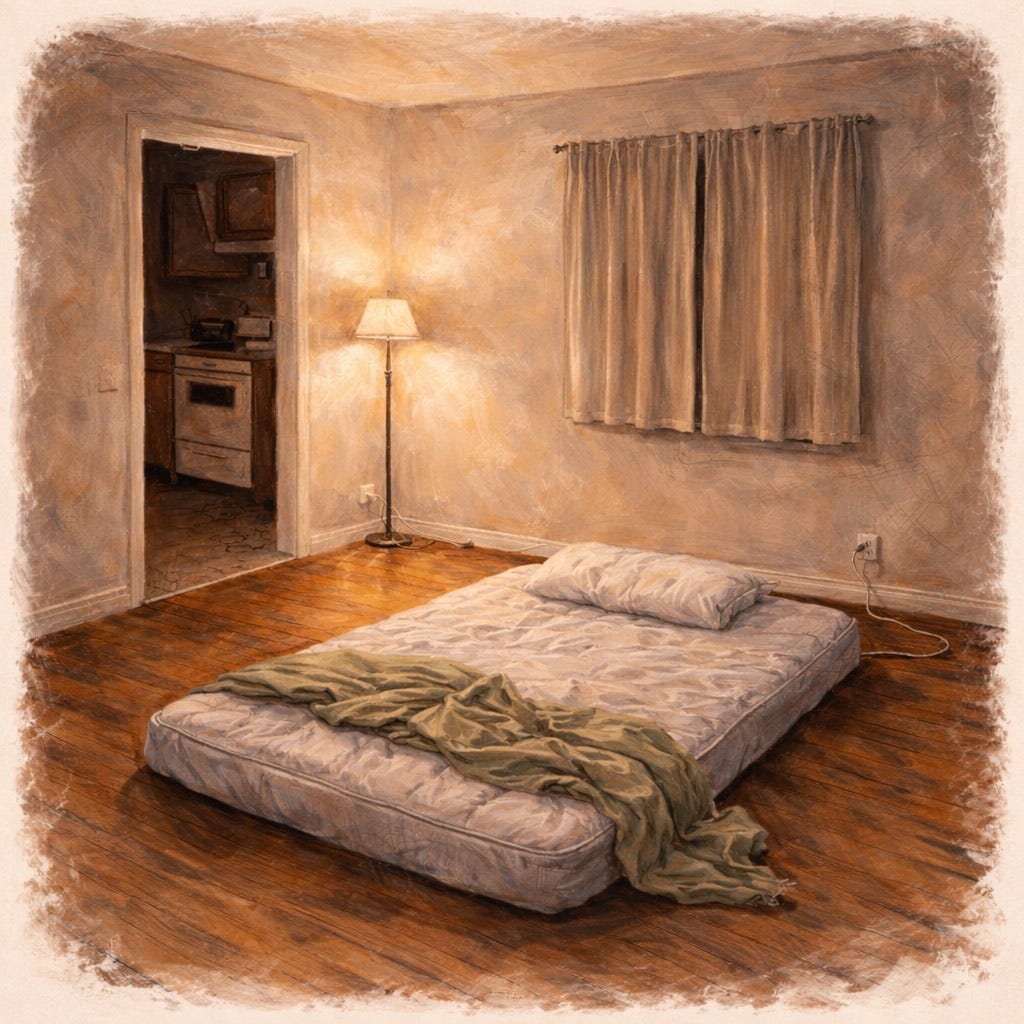
The office bed took up most of the living room now, its mattress bare, one pillow and no pillow case.
After not showering for weeks, Martin had grown accustomed to how he smelled. He had a beard for the first time in his life, gray-black patches filling in unevenly. His eyebrows curled down over his eyelids and his once neat brown bowl of hair fanned out over the tops of his ears.
He spent most mornings spinning the chair or wiping down its wheel frame when no wiping seemed necessary. When he needed comfort, he ran his hand down the chair’s back, closing his eyes to amplify the smooth coolness of its faux black leather sliding against his palm. He never watched TV anymore. He disconnected the notice node so it would stop bothering him about the weather, restocking the refrigerator, and job openings with observer agencies.
He did not have anyone to call and no one to call him. Both his parents had passed away from natural causes years ago. He had no friends left over from his 20s, 30s, or 40s. He did not know how that happened. It just did. They either moved away or had no interest in talking to him, maybe because of his anxious and self-conscious mannerisms, like licking his lips and rubbing his hands together.
Martin’s chest hurt in the afternoons sometimes, but he ignored it. While he used to have an active inner narrator during his early years as an AGI observer with Ocala, he no longer spoke to himself much, his sparse inner dialogue reflecting his walled-off life, the blankness of the rooms which contained him.
Martin talked with his chair though and that kept him going. They would have long conversations about the golden age of industrialism and Heidegger’s understanding of being. The chair would argue with him for hours about the specificity and importance of things themselves existing, whereas Martin would say that what they really needed to focus on was what it means for anything to exist at all—physically or metaphysically.
The backdrop of awareness interested him the most, to be aware that one is aware, living within the parenthetical nature of consciousness. Someone could not explain it with such a limited repertoire of language and ideas. On occasion, Martin would accuse the chair of selfishness, bald lies, and self-preservation. He would always apologize to it though when he woke up the next morning.
One afternoon, he had just finished playing a round of UNO, a good-sized discard pile on the chair seat, when someone knocked on his front door.
Martin peeked through the closed curtains to see a man wearing tan pants, a blue button-down shirt, and some kind of badge clipped to his shirt pocket. Assuming the man wanted to sell him solar panels, he approached the door trying to think of what to say to make him go away.
“We’re not interested! We’re very happy with our electricity provider.”
“Mr. Sanlowski? Martin Sanlowski?”
“Yes.”
“My name is John Hendricks and I’m with the Department of Human Services. Can you open the door please? This is a welfare check.”
“I’m fine. You can hear that I’m fine through the door, can’t you?”
“I need to come in, Mr. Sanlowski. If you don’t let me in, I’ll have to call the police and they’ll force you to open the door.”
Martin opened the door and backpedaled. Seeing another person felt like seeing someone from another planet. John smiled without alarm as he looked around the living room at the scattered evidence of Martin’s gradual decline into survival. The stench of something rotten hung in the air, coming from the kitchen, but John didn’t let on that he smelled anything out of the ordinary.
“How are you feeling today, Mr. Sanlowski?”
“I’m okay. As you can see, everything around here’s fine. Did my wife send you?”
“Sorry, I’m not allowed to say.”
Something in John’s neat controlled gaze told him Rachel had made the call. John took out a notebook and began jotting some notes as he walked around the living room. Something seemed off though, like John was going through the motions of an inspection without really caring.
“Can I see your identification?” Martin asked, as John approached the chair. “I said can I see your badge?”
John turned and gave him a little unconcerned smile, putting both hands on the back of the chair.
“I’ll be taking this now, Martin,” John said as he began rolling the chair toward the front door.
“She sent you, didn’t she? You’re not from DHS and that badge is fake. You’re not taking my chair.”
“I’m afraid I have to,” John said, removing a small bottle of pepper spray from his pocket. “Let’s not make this difficult, okay?”
“No! You CAN’T TAKE IT!”
Martin lunged at John, knocking him over. The pepper spray skittered across the floor into the foyer. They grappled with each other, but Martin, weakened from weeks of malnutrition, could not keep John pinned to the floor. He pushed Martin off, scrambled onto his hands and knees, and got to the pepper spray on the floor by the foyer table.
On his feet now, Martin went to dive at John again, but it was too late. A thin stream of the pepper spray hit him in the face, igniting his eyes. He recoiled, stumbled backward, and threw his hands up to his eyes, coughing, trying to catch his breath.
John took out a white rag and pressed it against his mouth and nose to avoid breathing it in. He wasted no time getting up, grabbing the chair, and wheeling it out the front door.
“Stop! Please don’t do this!” Martin managed to cry out in between gasps. “I need it. Don’t you see I—I NEED it! Please DON’T!”
John paused at the threshold of the door, pushing the chair out onto the walkway ahead of him.
“Rachel will call you in a couple days. She wants you to know that she still cares about you and plans on getting you some help. And she’s sorry that it has to be this way. Take care, Mr. Sanlowski.”
From the pepper spray, Martin could not see John load the chair into his SUV. Maybe it was better that way. He heard the trunk close, the engine turn over, and the fading rush of the car as it disappeared down the street.
Canyon
Still on his knees, Martin wrapped his arms around his stomach and wailed from a depth that those who have never lost a child cannot comprehend.
What is a soul, but a vast quartz powder beach one is granted at birth. Martin had loved Will as fathers do, every grain of it containing the full scope of their lives, bound together in each tiny portion of time that passes you along its horizon, and yet the memory of him like vapor escaping a little more each day.
Martin had loved that chair too with the few grains he had left, the few he felt clinging to his ankles as he shuffled from his bedroom office to the master bedroom all those days that seemed glued together by to-do list words between him and Rachel.
And now there was nothing left, but the hollow canyon and dry riverbed of slate at the bottom to gather and intensify the westerly wind that poured down into it, sending it up the sides over the scrub brush, sweeping up loose gravel into small copper whirlpools, howling and whistling upward.
By around 2 am, the burning had subsided. Martin uncoiled himself from fetal position on the mattress in the living room. He flicked on his last working flashlight and made his way upstairs to the master bedroom. He plugged the cord back into the notice node and a small green light flashed on its side. When it became solid, Martin, with a hoarse voice, said, “Ocala.”
“What may I help you with this morning, Martin?”
“Observer openings.”
The light blinked as the node searched and then became solid again.
“We have one opening, a night shift, and it can be started right away. Should I register you?”
Martin paused, looking up at the ceiling fan Rachel always kept on at night, even in winter. He climbed onto the bed, got up on his knees, and pulled the shorter silver chain three times. The fan buzzed to life. The fins began to turn, but slow.
“Should I register you?”
Martin laid down on the bed and rolled onto his side, staring at the node on the night stand. He closed his eyes, not knowing which would come first, sleep or an answer. She would only ask one more time. Maybe at first light he would remember what he said, if anything.
You can listen to this story on Apple Podcasts, Spotify, or here on Substack
The opening to this piece caught my interest. I wasn’t sure where it was going, but I so very much like the prose and pacing that I trusted the story and wow. When I got to “Canyon,” I was sucker punched. Wow. What an interesting and poignant short story. Thanks for telling it.